Showing posts with label daniel gauss english tutor. Show all posts

Saturday, June 4, 2016

Steve Moseley - Patience Bottles; Curated by Leonard Cicero at INTUIT (Chicago)

Bourbon is a type of whiskey originating from the American South (made from corn), deriving its name from the Bourbon dynasty in Europe. Steve Moseley has been taking empty Bourbon bottles and creating little religious and socio-political dioramas inside of them. 

{{{click on images to enlarge them}}}

Here we see a child confronting an evangelical minister with the question of whether cavemen had souls or not. Moseley seems interested in presenting the drama of a child asking a type of question she is not supposed to ask, since either a "yes" or"no" from the minister would undermine the entire belief system he has been promoting (If cavemen did have souls, why send Jesus to earth? If they didn't, why would God sacrifice zillions of pre-Christian people to oblivion?).

Actually (exercising my pedanticism here), as a guy who has studied the evolution of religious thought, the religion of hunter-gatherers was 'shamanism', which was not a religion of 'self-development'. It was a religion involving specialized holy men/women who could connect to the spirit realm to gain very practical help for hunting and gathering societies (the curing of illnesses, success in hunting, pain-free birth for the women of the group etc.). The concept of the soul and spiritual development only happens when cities begin to arise and ethics gets tied up with religion. Hunter-gatherers believed/believe their spirits survive death, but they do not believe in souls that will be judged. But, pedanticism aside, Moseley's little drama works fine as a little peek into the religious life of the deep South.


Here is Jesus playing basketball against some demons.


Moseley can be satirizing the extent to which our concept of spiritual development is tied up with notions of competition. If we want to gain salvation we must literally "beat" the devil.


Here Moseley pokes fun at the out-dated values concerning women found in the Bible as Adam tries to hand Eve some dish-washing powder.


This bottle is labeled: If you vote for Trump you will receive no absolution (forgiveness).


Here the Pope is asking Jesus to wear nicer clothes.


So why create these scenes in Bourbon bottles? Well, Moseley is from the South and he could be equating the absurdity in the bottles to the potency of this very Southern liquor. This is part of the culture of the deep, white South and it is absorbed as easily as Bourbon. The scenes definitely are surrogates for the Bourbon.

What is interesting to me is that wine is very symbolic in the Christian religious tradition. When one drinks wine, one becomes elevated...one becomes more tolerant, loving, social, forgiving; wine was the blood of God that changed us for the better. Jesus was the true vine and one drank wine to remember Him. Bourbon, on the other hand, with its ties to Southern culture and history, seems to be a corrupter of God's true word. It seems to indicate that man cannot live on an alcoholic beverage alone - along with the intoxication one must have a sound intellectual and moral basis in place, or one might be drunk enough to vote for an utter buffoon like Trump, and rightly lose all possibilities for forgiveness.

------------------------------
Close-up of Adam/Eve in the garden


Adam and Eve after eating from the apple:


Your basic evangelical snake-handler:


Wednesday, December 9, 2015

Ling Jian - Nature Chain (or Mao vs. the Beauty Myth) - Klein Sun Gallery

{{{click on images to enlarge them}}}

As one enters Klein Sun Gallery, one of the first images in the new show of works by Ling Jian is of a strikingly beautiful young Chinese woman dressed, apparently, in some type of government outfit. Contrasting the effect of perfect makeup with a starched, white, official shirt collar, Ling seems to be addressing the erosion of Communist Party values dealing with the equality of women and highlighting the increasing encroachment of ‘the beauty myth’ into Chinese culture as a result of the post-Maoist open-door policy.

By extension, perhaps, he would also seem to be implying that the objectification of women is just one of those unfortunate concomitant factors that goes along with welcoming western progress – like the Chinese workers jumping from the roof of an Apple factory because they can’t bear the poor wages and slave-labor hours.  The irony is that by embracing the ‘western’ concept of beauty, the woman in the uniform puts one more nail in the coffin of one of the best ideals of the Chinese Revolution – the dignity and full human potential of women.


So a big part of what I liked about the show – and this may not be exactly what the artist’s actual statement is – highlights the fact that western-inspired globalization is not a pure, Hegelian process of inevitable, spiritual and moral improvement. It seems to have brought whitening creams to South-East Asia as well as plastic surgery and mind-numbingly exploitative K-pop to Korea.


So the one thing Mao got right becomes the first thing to die, now that Deng opened the door. Or Ling could be saying that the Revolution never really changed underlying conditions that had developed in China – for a brief time sexism was held down through a massive state apparatus. Now it’s blossoming from out of starched, white collars. About 25% of contemporary Chinese women experience domestic abuse, including marital rape. There’s a Chinese saying going back generations: “If you don’t beat your wife every three days, she’ll begin destroying your home.”


So, to me, being confronted by these huge, beautifully executed canvasses morally challenges the viewer to examine his/her role in this whole process. On lingjian.org the artist is quoted as saying, “I attempt to multiply the power of temptation by displaying it on my canvases.”  Men who view these paintings are not challenged, as male painters used to challenge men in the past, to indulge in fantasies and derive prurient visual gratification. This is a male painter throwing a corporate-inspired sexual exploitation in our faces and asking us how stupid we could be to buy into this garbage. To women, he seems to be asking how stupid they could be to cave in to the pressures of demeaning and objectifying themselves. Sure it looks glamorous, but think!

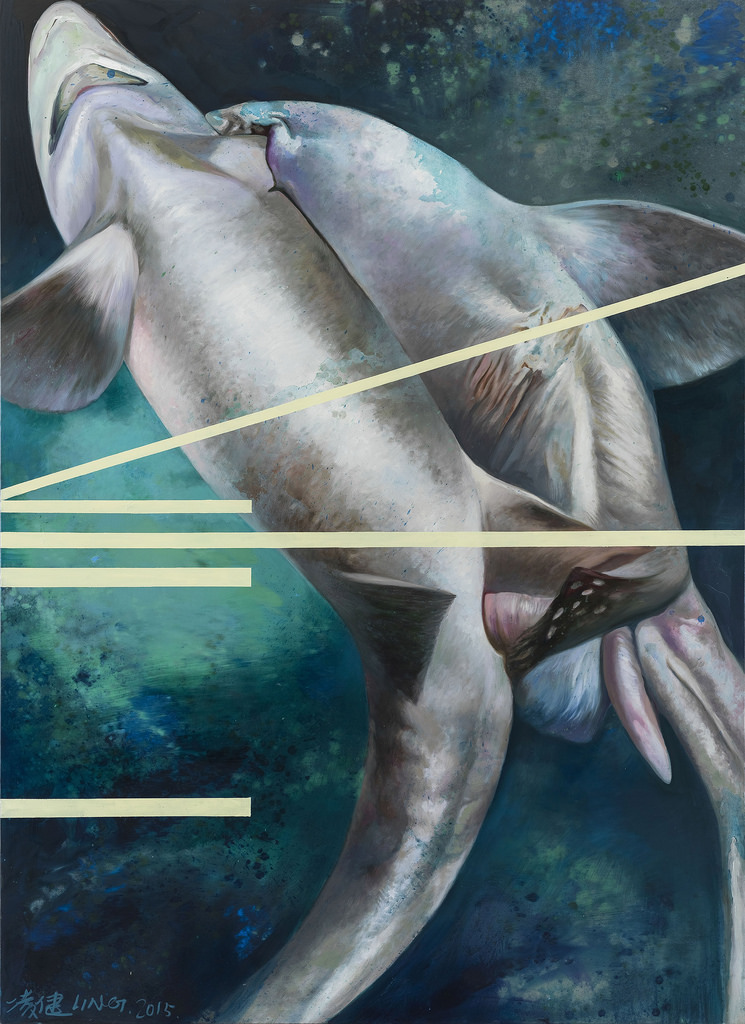
{{{I'm pretty sure this is a shark vagina.}}}

To bring this point home as forcefully as possible, I am assuming, he also includes realistic paintings of sharks copulating in the show. There is a wry, pessimistic humor in this as well.  The show is called “Nature Chain” and I would guess it is because the folks who profit from causing women psychological torture through bizarre conceptions of female ‘beauty’ tend to argue that these forms of exploitation and abuse are ‘empowering’ to a woman and natural. So you turn a corner in the show and go from ultra-thin, sexually charged Chinese ladies to sharks fucking each other.


In the past, western artists could get away with portraying women as objects of sexual desire because the female figure was often used allegorically at the same time. In much epic literature a spiritual quest is often defined in terms of a wandering man (representing spiritual desire) seeks to return home to a loyal woman (representing the fulfilment of spiritual desire – the union of ‘active’ and ‘passive’). Ling deliberately drops the allegory and just presents the sexualized woman. He seems to be pointing toward a need to recognize the need to abandon the female subject as something overtly sexualized while demonstrating how potent the attraction is to buy into this.


Some feminist artists – like Joan Semmel - have experimented with non-sexist visual imagery of sexual relationships and sexual union. Ling’s work also seems to point to this hopeful possibility that with the disintegration of an ideology, there still may be hope for greater humane development.

Monday, November 9, 2015

The Lie of the Purely Figurative or Gestural: Erin Smith at Amy Li


{{{click on images to enlarge}}}

In many of the pieces of the work of Erin Smith, there seems to be a conflict between the gestural and the representational which helps bring the relationship between perception, judgment and emotional response into greater focus.  It is as if this relationship, in fact, gets in the way of pure representation, pure abstraction and/or pure process art. In fact, one flaw inherent in the type of abstraction which purports to reveal inner states of being might be that the inner states depicted are always divorced from the surrounding context generating the experience. Can we look inside ourselves and just perceive emotion? Can we look at inner states alone, divorced from everything else? Doesn’t the process of introspection involve experiencing a muddled confluence of images, dialogues, fears, desires etc.? Pure, representational visual imagery and pure abstraction both seem to become lies to Smith.


Just as it might be wrong to say there is a reality separate from the mind, it might be just as wrong to assert that there is a mind separate from the outside world. In the work of Smith we seem to see an attempt to find a point where the unity of inner and outer reality blend in the process of expression. It’s as if Smith is saying we can’t look at the inner world without reference to the outer world and vice versa. The process of introspection is multivariate and complex and, furthermore, not all of it has to be caught in the process of introspection for introspection to yield meaningful results. Smith seems to hint at what we should look for when we look inside and outside at the same time.


So an artist might choose an image because it is laden with some type of meaning, but in the process of depicting an image, Smith seems to assert that the artist must allow inner responses to the image to come to the fore and vitiate the clarity of the image.  So in the current show we have an image of some military character with a wry smile on his face. Perhaps it’s the wry smile in conjunction with the military uniform that was meant to be expressed to those who would also ‘get’ what this means on a literal or allegorical level. Yet the artist cannot refrain from confessing her own inner state in the process of sharing the image. This smile and uniform seemingly initiates raw emotion in the artist which also makes it to the canvas. The image elicits the responses, yet, one is also capable of assessing the legitimacy of one’s emotional responses, and this process also seems present in the tumult of the paint on the canvas.


Some of Smith’s work is more representational or abstract than others. In one piece salient aspects of the human figure are almost totally eliminated through harsh brush strokes of thick paint. Just a hint of the initiating factor for this emotional display is present as emotion and grappling with emotion fill the canvas and obscure the image. It’s as if Smith is saying that perfect photo-realistic clarity would equal total emotional equanimity and she seems to be asking whether this state might ever be attainable in our relationships to others and events in the world.


Amy Li does a yeoman’s job of bringing thought-provoking and meaningful art to her gallery on Mott Street regularly. She seems interested in finding real artists, engaged with real issues and creating real art. Recently I read an interview with a gallery owner who categorized artists as “emerging”, “mid-career” or “blue-chip”. At no point did he talk about authenticity of expression or the desire to really engage others on a meaningful or transformative level. He didn’t talk about artists as seekers trying to get their new findings out there to the benefit of other seekers and doers. To this owner, and maybe to many artists, the expected progression of an artist has to be expressed in terms of whether or not the artist is moving toward greater and greater economic success. The more upper-middle class you become through your art, the more ‘blue-chip’ you become.  Attaining an upper middle class life style becomes the be-all and end-all of the artistic endeavor. By this time, the artist is, however, basically just forging his/her earlier work for a market that knows what to expect and rewards one for meeting such (low) expectations.


As well as finding amazing artists who are really involved in the significant processes of creation, Li bucks this financial orientation and trend by trying to keep the art at her gallery affordable and by working with buyers who want art for all the right reasons. I’m not a PR rep or a salesman, but if you have some extra dough and want to support genuine artists and  galleries, and want to own something thought-provoking to share with companions, visiting Amy Li Projects or other galleries of this type would be well worth your while. ‘Invest’ in pharmaceuticals, ‘support’ art. The show by Smith is going to be extended a few more days and you can see it at 166 Mott Street and you can reach Amy LI through her website at www.amy-li.com 


Wednesday, September 30, 2015

Perras y Putas: Yapci Ramos at Catinca Tabacaru Gallery, Lower East Side

{{{click on images to enlarge}}} 

An overabundance of stray dogs is a clear indication that a society is suffering in general terms. That’s why people readily believed, a few years ago, that Detroit had about 50,000 stray dogs when this figure was erroneously reported in a couple ‘reputable’ news sources. Other, more reliable, estimates guessed at 1,000 to 3,000 stray dogs in Detroit. People falsely bought into the claim of 50,000 stray dogs because they believed that life in Detroit is tough: the tougher life is in a city, the more stray dogs you’ll have. Of course we also know that one way Vladimir Putin went about showing the world that Sochi was a wonderful, developed place was to shoot and poison the massive numbers of stray dogs before any Olympic tourists arrived.  Who needs to solve underlying problems of poverty when you can use the state apparatus to just kill the dogs and hope other dogs don’t show up until after the closing ceremonies?


When Spanish photographer Yapci Ramos arrived in Aruba, she noticed a lot of stray dogs. The notes from the show at Catinca Tabacaru Gallery on Manhattan’s Lower East Side quote her: “Aruba is a small island full of stray feral ‘perras’ (bitches) surviving as best they can; languorous bitches, fierce bitches, vulnerable bitches, flea-ridden bitches, quiet bitches, aggressive bitches…bitches.” Ramos presents photos of prostitutes she has met in the Canary Islands and the Republic of Congo in her current show, along with these stray dogs from Aruba. So although the show is called “Perras y Putas” and could, possibly, be translated as Bitches (female dogs) and Bitches (prostitutes/whores), it seems clear to me that the dogs represent or evince a pervading social and governmental apathy in the types of societies where many sex workers are compelled to make their living.


The presence of the dogs indicates that the women in these photos are not a part of the state-regulated prostitution of ‘developed’ European nations, which makes the profession more palatable to its well-heeled, power-wielding inhabitants. This is not the prostitution of feminist empowerment in this show, but prostitution as a survival mechanism with adverse consequences to the sex worker which are hard if not impossible to capture through the medium of photography.


To me Ramos deliberately, perhaps, reveals a significant limitation of photography and, by combining the photos of the dogs and the women, the show seems to acknowledge this limitation and searches for ways to compensate for it. To what extent can the photographer really capture the process of life that these women are going through? By including the dogs as examples of a society’s overall poverty, ignorance and callousness, she ingeniously sheds some light on why these women are doing what they are doing and how they may be affected by being what the show’s notes call private individuals with “public bodies”.


One of the more famous photographers of prostitutes was, of course, E.J. Bellocq, whose work from about 100 years ago in New Orleans was discovered and promoted by Lee Friedlander in the 60s and 70s. Bellocq, who may have been physically deformed and is therefore sometimes compared to Toulouse Lautrec, seemed to enjoy hanging around the various brothels in town and took photos of the prostitutes he apparently idolized, revealing aspects of individual character in settings that revealed relative comfort. The prostitutes seem content and jovial in Bellocq’s work. Ramos seems to present her prostitutes in the type of tradition that can probably be traced back to Bellocq; we do not see them suffering and some even seem content and happy.  In some of the Congo photos, the women seem to revel in their situations.


The photos therefore beg various questions: If these women seem to be OK, why should this be my business? Unlike powerless dogs, these are human beings with the capacity for choice and agency – should I really care about them? Yet, one can ask whether they truly made any significant choices or whether they were subtly and inevitably coerced through the structure and functions of their societies into situations where they had to spread their legs on a daily basis to make a buck or two to survive. Just because they are happy doesn’t mean this is right or that they are being given the best possible choices for their lives in their given societies. We often make the best of rotten situations.


The key to absorbing what these photos offer is that these women are not living in abject poverty, yet, can we say that their lives are meaningful or that they would even keep these lives if other opportunities arose? Just how do we or should we engage these women staring at us from these photos, flanked by hungry, desperate, frightened dogs? To a great extent, these women may be proxies for many of us – living lives of relative comfort while doing something we abhore, wondering whether there might be something so much better for us.


This powerful and affecting show runs at Catinca Tabacaru Gallery until October 11, 2015. If you are trekking through the Lower East Side galleries any time soon, this gallery, which regularly presents amazing work, would be well worth your time.

Sunday, June 14, 2015

Bushwick Open Studios Highlight: Satirical Animated Paintings by Federico Solmi

{{{click on images to enlarge}}}

So Gilbert Stuart painted the iconic portrait of George Washington we can see at the National Portrait Gallery. And Washington deserved a nice big portrait, didn’t he? After all, he beat the English so that we could gain our freedom and he served as first president. Yet, a reputable historian has suggested that George Washington may have supported the American Revolution primarily because he had horribly mismanaged his finances in regard to his tobacco plantation and was hopelessly in debt to English businessmen – nothing like booting the debt-holder’s army off the continent to relieve your financial crisis.

Gilbert Stuart - Washington - National Portrait Gallery

Furthermore, George’s generaling skills were not always what you’d have hoped for. In a battle in Manhattan he stupidly allowed about half of his army to get captured and these men languished and died slowly and agonizingly in English prison ships (you can visit their monument in Fort Greene Park). For big chunks of the war he, basically, did nothing but maintain a camp. At the Battle of Yorktown – the final battle of the war – it was the thousands of French soldiers and the French navy which made the difference, and Washington was not even allowed to create the strategy for the battle since the French king did not trust him with such a large chunk of the French military. Basically King Louis said, “We’ll let you be there George, but we’re running this show, baby. We’ll do the work, you take the freaking glory.”


So this lionizing process of first obfuscating mediocrity and then elevating the mediocre and greedy and power-hungry is what Federico Solmi seems to lampoon in his visually stunning animated paintings which were one of the highlights of the Bushwick Open Studios.  Solmi will be having a show in LA at the Luis de Jesus Gallery in which three of the works he showed in Bushwick will be displayed as part of a new series called The Brotherhood. The ‘Brotherhood’ is an organization which has been comprised of ‘leaders’ of now mythic proportions (and future ‘leaders’ of mythic proportions) who have had the goal of maintaining ‘chaos in the world’ while working toward ‘the degeneration of the human race’.  The three members of the Brotherhood that will be shown in LA are Montezuma, Washington and Columbus. In these ‘animated’ paintings, you see figures attempting to move with grace and decorum through public areas to receive adulation, but something seems horribly wrong.


These animated paintings are like Dorian Gray images where the truth of each exalted and grandiose person suddenly winds up making it to the forefront even though the public image will remain pristine and unchangeably perfect and magnificent due to the lack of real journalism and the existence of public apathy. Solmi seems to attack the false narratives that get written about most leaders – that they are driven by integrity, concern and compassion, when, in reality, each one is driven by an all-consuming desire for power, fame and money. Each of the members of the Brotherhood has mastered the art of demagoguery and rhetoric and will say (perhaps from a teleprompter) what people want to hear while pursuing his/her own agenda.

Solmi is a past winner of a Guggenheim Fellowship and has been exhibited widely. There will be a gallery show of his work in New York at Postmasters Gallery on 54 Franklin Street on September 9th.  Join him on Facebook and he’ll let you know the details. You should be able to access one or two of Solmi’s non-Brotherhood pieces below, to give you an idea of how he uses technology from the video-game industry, as well as more traditional materials, to create these large, framed video pieces.


The artist’s web page:

www.federicosolmi.com


Daniel Gauss - a guy who is pretty damn good at writing about art :)


Daniel Gauss


Monday, June 1, 2015

Karl Weiming Lu at Andre Zarre (Origins)


Karl Weiming Lu was a member of the first generation of Chinese artists, after the end of the Cultural Revolution, to seriously begin experimenting in the visual arts. This movement is usually cited as having begun in some of China’s larger cities around the year 1985 but it only lasted a few short years as the government soon cracked down on such expressions of individualism around 1989, the year of the Tiananmen Square horror. This crackdown seems to be one of the reasons we see so much representational work coming out of China, although Chinese artists have cleverly learned how to make political and social as well as deeply meaningful personal statements through super-realism and other types of representation in response to an official frowning on more experimental techniques (although you do sometimes get experimental techniques coming out of China anyway).


Lu now lives and works in Sydney and he apparently first created his ‘dripping flow’ technique in the 2000s as part of a series he did on the theme of memory. For his current amazing show at the Andre Zarre Gallery, his work seems focused on the paradox we live with every day and which should probably be driving all of us nuts – how could the universe come from nothing or how could there have always been stuff/energy from which to derive a universe? As the old rhyme goes: “How could something come from nothing? How could something always be? It’s the riddle you can’t answer. It’s the answer you can’t see.” Basically, if we are to trust the human intellect, nothing should exist.


To be honest with you though, when I saw Lu’s work at Zarre, I liked it because it seemed to employ the perfect technique to capture the central problem of memory for me. Memorizing stuff that we see or sense is fine. Memorizing information is fine. The real problem happens when we have meaningful or transformative experience in our inner reality and try to capture that for further use. That doesn’t seem to work well and the process seems to degenerate or deteriorate in the way that we see Lu’s paint dripping down his canvases from his arches or spirals or other figures. When we experience some motive or emotion or any type of inner process that we find valuable we attempt to make it more concrete or we attempt to create a visual representation for the experience, but the experience becomes lost and the visual markers soon lose any meaning. So I see a bit of process art in Lu’s swirls and spirals – we see a beginning and ending of a process but at the same time we see the deterioration of the experience as it is attempted to be shifted into a more usable cognitive form.


The paintings also work, however, as an investigation of origins and our attempts to capture that which seemingly can’t be captured.  In Marlowe’s Dr. Faustus, Faustus flat out asks Mephistophilis how the universe came into being and Mephistophilis becomes outraged. Even the chief representative of Satan can’t tell Faustus how the universe came into being. Lu’s abstract images and his technique in creating these images seem to capture our constant attempts and constant failures to crack the one nut that seems impossible to crack.


Karl Weiming Lu
Recent Paintings
May 21 – June 25, 2015
Andre Zarre Gallery
529 W. 20th Street

New York, NY 10011

Friday, April 24, 2015

Wasted by Deborah G. Nehmad at Kim Foster Gallery (A Show about Gun Violence in America)

{{{click on images to expand them}}}

Deborah G. Nehmad uses paper as a type of surrogate material for human skin, and, therefore, by extension, for the human body.   On her website Nehmad writes: “…the processes I employ – I repetitively burn, etch, scrape, score, stamp, puncture, type, apply pressure, write and draw – and materials I incorporate – heat, paper, gut, glass, ink, thread, soot and metal – offer a visual vocabulary that seems to parallel the way pain marks a body.”


In her current work Nehmad uses her method to step back and look more broadly at gun violence in America, trying to create a graphic representation that might affect the viewer more viscerally than graphs or statistics. Using handmade Nepalese paper Nehmad burns holes and makes stitches to represent individuals killed through the use of guns. Nehmad represents deaths by homicide, suicide as well as deaths caused by the police. The deaths of children due to gun violence (through homicide and suicide) are also graphically represented to differentiate them from other types of gun-related killings. 


For the central image or background of her graphic representations of the numerical effects of gun violence, Nehmad uses giant circles. The irony is intended – the circles can, obviously, represent gun range targets.  Yet, circles can also represent a type of unity. The blotches caused by the burning and stitching marring these circles can represent the type of harm being done to our communities.  We live in a culture where our education does not extend to teaching each other how to handle our rage or how to address factors more humanely that might otherwise cause us to fly into a rage. Our popular culture, in fact, encourages rage. The consumerist nature of our society also allows us to purchase the means by which we can more easily act out our rage. The pieces suggest that the whole emphasis of our society involves ignoring or denying a type of humane personal development that can resolve conflict and, instead, embraces violence as the best solution to all of our problems. We see this in individual social interactions as well as the overarching ‘ideology’ of American foreign policy.


The show points to a problem right at the heart of contemporary American society. It’s easier to attack and lash out than it is to view the other as a fellow human being worthy of respect and compassion. We teach malice and not compassion or understanding. In fact, it’s more profitable when folks attack and lash out so these unnecessary deaths depicted in these pieces will undoubtedly continue for the foreseeable future. In this show guns become symbols of the absolute refusal to believe that it is possible to live like decent and compassionate human beings. The images show the effects of this refusal to even attempt to establish a humane ideology as the basis of our culture.


Deborah G. Nehmad
Wasted
April 9 – May 9, 2015
Kim Foster Gallery
529 W. 20th Street, groundfloor
New York, NY 10011
www.kimfostergallery.com


Friday, April 17, 2015

Brian Maguire - The Absence of Justice Requires This Act - Fergus McCaffrey Gallery

{{{click on images to enlarge}}}

The city of Juárez Mexico has launched a public relations campaign. Heartened by the fact that the city went from the #1 ranked murder capital of the world, just a few years ago, down to #38 these days, the authorities want you to know that “Juárez is waiting for you!” Yep, it’s right over that big fence the US government put up a few years ago. No need to fear kidnapping, murder, mutilation, torture, gang rape nor extortion, according to a January article in London’s Daily Mail, all of that has conveniently moved east to the Juárez Valley where the Sinaloa and Juárez cartels may still be at war with each other, even though the Sinaloa cartel may have finally secured control of Juárez City (ergo the decline in killings). The population of “Murder Valley,” nevertheless, has dropped from 60,000 to 5,000, fertile cotton fields lie unused, ghost towns abound, folks are tortured, have their heads cut off, ransom money is sought, folks get mutilated. Same old same old – but it’s no longer in Ciudad Juárez and it’s on their side of the fence.


Irish painter Brian Maguire has worked regularly in Juárez since 2010 (when 3,622 people were killed) and has 14 powerful and affecting pieces currently on display at the Fergus McCaffrey Gallery which he completed from 2012 to 2014. His documentary film Blood Rising is also being shown. This is about the ‘feminocidio’ – the murder of 1,400 young women in Juárez since 1994. If you drop by the gallery please give yourself enough time to sit down and watch this.

Of course, if we look at the history of art, before Daumier and Courbet, social suffering, or the plight of those who had been marginalized or victimized by other segments of society, was, essentially, ignored.  Bourdieu points out that the depiction of social suffering begins more regularly in art during the class conflict of the 19th century.  Basically, the only ‘suffering’ depicted in Western art before that general time seems to have been the suffering of Jesus, Christian martyrs, people in hell or mythological figures.  When social class did become apparent in art, before Daumier, the peasants were often idealized and did not seem to be in any real pain. With the rise of the middle class and representative governments in the 19th century, we also seem to get the creation of a ‘journalistic’ or ‘activistic’ concern for identifying and solving social problems.  The depiction of social suffering, suddenly, in the 1800s, became possible in art.


Many of the images of the Maguire show go beyond mere documentation of social suffering and invite a reflection on our capacity to be inhumanly cruel. It’s Melville’s “Mystery of Iniquity” question restated. What is it that can push a person so far as to calmly hold a telephone over a woman being raped so that her father can hear what’s happening (in order to exact a ransom fee)? Or to contact a relative about a ransom and then to suddenly increase the ransom price because the family was too eager to pay? Where does this come from? Is it circumstances? Do we all harbor this capacity? What stops most of us from sinking this low? What pushes some of us to plumb these depths of moral depravation and insane inhumanity? Maguire is not trying to capture suffering in these paintings, he is shooting for horror. He is trying to convey the abject horror of what was happening across a river and a fence from us in a relatively small city due to the raw greed, lust for power and ambition of human drug traffickers and the federal police in Mexico who were apparently stuffing their pockets while all this horror was occurring.


Indeed, the Washington Post reported that 1,286 cities in the USA have been infiltrated by the Sinaloa drug cartel. Chicago is a major hub for the Mexican drug pushers who use the massive street gang infrastructure (100,000 members) to peddle drugs to African Americans in the racially segregated inner city. So Maguire is also saying that this is not really on ‘their’ side of the fence. The Mexican Federales are not the only incompetent and corrupt buffoons allowing this horro, we may have our own incompetent and corrupt politicians and police looking the other way or stuffing their pockets. Over $20 billion goes back to the cartels from the USA each year. When upscale New Yorkers buy their weed or cocaine, money might be going straight to these guys to support their operations. Some folks won’t eat meat, but they’ll buy drugs and help keep a murderous cartel in business.


So Maguire, weaned on the injustices suffered by the Irish under foreign control, follows brilliantly in the tradition established by Daumier and Courbet. He doesn’t challenge us to stare in mawkish, voyeuristic  wonder, but, instead, he challenges us to get angry, to really become aware and outraged. His images demand that we acknowledge that a fence isn’t good enough. We need to fix our social problems and be aware of the need to help our neighboring ally to address inequity and poverty there as well. He seems to want to shake us out of the lethargy and self-absorption of our safe 1st world society, to demand justice for those our government has put behind a fence to suffer whatever the drug lords decide they can get away with in a society where the government (and ours) might be too corrupt to take effective action to protect its people.