Showing posts with label max ferguson. Show all posts

Monday, June 26, 2017

Interview with Max Ferguson - Yes, that's a painting, not a photo!

{{{Strand}}}
Click on images to enlarge them.
Originally posted on wsimag.com
Max Ferguson, to me, achieves a type of ‘urban mysticism’ in many of his paintings through the placing of people in seemingly pristine city environments. Although, as he mentions below, his work is becoming more oriented toward interiors, many of his past figures were often alone in public places, waiting or engaged in a temporary activity. The spotless nature of the setting seemed to better highlight the isolation of the individual in that venue. This technique more forcefully brings out the contrast between the relative permanence of the place (with its impersonal function) and the impermanent and fragile nature of the individual.
Adding a deeper layer to this is the fact that Ferguson has often depicted his father, who died before many of these works were completed, in many of these settings. Before his death Ferguson’s dad had functioned as a type of urban “Everyman” in his son’s work. Perhaps as a defiant gesture born of a deep sense of loss, the father now becomes as permanent as the city, giving each place a more human and humane meaning and impact. The unnaturally anti-septic nature of the subway station or Katz’s deli now takes on another potential meaning, implying the integration of place and remarkable person in an idealized relationship beyond time, the second law of thermodynamics and grime. Moments of transition and everyday activity thus begin to reveal a serenity either approximating or embodying the sacred.
Ferguson is one of the premier ‘realist’ or ‘representational’ painters in the world and is currently represented by Bernarducci Meisel Gallery in Manhattan. He has work in major collections and museums around the world, including the Metropolitan Museum of Art and the British Museum, London.
{{{Nightwatch}}}
Do you consider yourself a ‘photorealist’ – I ask this because I just learned your style was more influenced by Dutch ‘Golden-Age’ painters than the photorealist tradition. How did these Dutch guys impact you? Who in particular?

I do not consider myself a photorealist. The difference between photorealists and my paintings is the difference between having sex and making love. I suppose if I have to be put in any box, it would be “representational artist.”
I spent a very key year in my life in Amsterdam attending an art school there (Gerrit Rietveld Academie). I was initially attracted by their technique (I was a student trying to learn my craft). But another main factor was the subject matter; much more down to earth than Southern European old masters. My love affair and influence of Dutch seventeenth century art continues to this day. My main influences are Vermeer and Gerrit Dou. For me, the ideal artistic marriage would be Vermeer and Hopper.


{{{Laundromat}}}
In an article about you, the author mentions you felt some Dutch painters made everyday objects and everyday life seem sacred. Are you shooting for the sacred… in New York City?

One of my many goals in my work is to make the ordinary, extraordinary, and the mundane, holy. I feel I am most successful if my models appear as though they are at prayer.
{{{Interiors}}}
Can you talk about the influence of Robert Kaupelis on you at NYU? Were there others who helped you get to where you wanted to be as a painter?

Robert Kaupelis was a wonderful man and patient teacher at NYU. He and I were very different in our visual goals (he was an abstract expressionist), but ultimately we both wanted to be as good artists as we could be in our chosen paths. He inspired me in that direction.
My biggest influence on me as a "teacher" was Ton Leenarts, a Dutch artist whom I got to know via my older brother. It was through him that I ended up in Amsterdam that year (78 - 79) and he somewhat inspired me to consider seriously becoming a professional artist. He also was a strong early influence on my work (emphasis on perpendicularity, painting his father, etc.) I probably would have become an artist without him, but I would have been a different artist. It is impossible to overstate his importance on my work and my life.


{{{Girl Looking at a Vermeer}}}
Many people have written that you seem to want to capture aspects of New York City that are dying. Is this true? You currently spend a lot of time in Jerusalem. To what extent are you painting scenes from there?

I have always had a hyper sense of carpe diem about me, and an extreme sense of the brevity of life (even from an early age). One aspect of my work (but just one) is the desire to capture elements of New York that I see are disappearing at an amphetamine-fueled rate. It is not so much that I am nostalgically looking backwards, as I am looking to the future to try to preserve these aspects of contemporary life for the future. I divide my time between New York and Jerusalem. I have done a few scenes here, but the vast majority of my work is still New York-themed.
{{{My Father in Katz's}}}
The Crown Heights Riots had a big impact on your life and art?

The Crown Heights riots were a catalyst for me to get more interested in traditional Judaism and come in contact with more religious Jews. My work is essentially autobiographical in nature, so naturally that was reflected in many Jewish-themed imagery. Some of these images were of some things in Crown Heights (a matzo bakery, for example).
How has your work changed since the 80s? What are your big concerns now? Do you see yourself heading in any unexpected directions?

There have always been some consistent elements / themes in my work. These elements slowly evolve. I find my work getting increasingly intimate, almost all interior scenes now. I have long held to the belief that the more personal you get, the more universal you become. As mentioned, my work is essentially autobiographical. Now that I am married with three children, some domestic vs. urban imagery has arisen. Also, employing my children as models, etc.
{{{Violin Repair}}}
I didn’t want to ask this, but when I take people to see your work, the first thing they say is, “Is that really a painting? It looks like a giant photo.” Then their next question is: “How long do you think it took this guy to do this?” Sorry for asking.

Time: The oils generally take from 2 – 4 months. My record (hopefully not to be broken) is 8 months. I do find them taking a bit longer lately, as they have gotten rather complex. Size affects the time factor less than one would think.
It has never been my intention that my paintings look like photographs. But I suppose the comparison is inevitable. Risking making a strained analogy, somewhat inevitably, all musicians with an acoustic guitar and harmonica are compared to Bob Dylan...all realistic paintings are compared to photographs.


{{{Popcorn}}}

Any contemporary New York City artists you are really into? 
I like Richard Estes and Phyllis Herfield very much.

Wednesday, December 25, 2013

Super-realism group show at Gallery Henoch

Gallery Henoch, in Chelsea, seems to be the go-to gallery for superrealist painting.  Its current group show of work by 10 artists is called ‘The City.’

Max Ferguson

Hyperrealism, Photorealism or Superrealism (call it what you will) is a resilient trend in contemporary art, which started, in part, as a response to various art movements of the mid-century and 1960s.  Superrealists wanted to assert (yet again) that there was still value in representing the perceived world as it might be captured at one moment in one place.  The difference, however, between superrealism and the realism of Courbet, for instance, would seem to involve the existence of the camera.  Instead of responding to the camera (as other movements did) with contemptuous attempts to do what the camera could not, the superrealists abandoned all pretenses and candidly admitted that the camera and photography does, indeed, exist and that photography can be a legitimate aid or even a starting point in the process of painting.

Max Ferguson

A point many people seem to miss, however, is that neither realism nor superrealism is really 'realistic.'  How, for instance, do we really know a given painting is an exact duplicate of a ‘real’ situation or a ‘real’ photo of a situation?  How do we know that what is represented on the canvas really does exist somewhere?  Actually, we don't and that's probably not the point anyway.  Despite the meticulously detailed style of a superrealist painting, there is, in fact, no real assurance of a correspondence between the painted image and ‘reality.’  What if, for example, a superrealist decided to paint stuff that was never photographed or which never even existed?  It could still be classified as superrealism. Realism and superrealism seem to refer to technique and not to any claims to be accurately representing something that happened or exists in the world.

There is, however, a huge difference between realism and superrealism. The key point would seem to be that in many superrealist paintings, the painter deliberately removes him/herself from the direct experience with ‘reality' that the realist painter often implies.  He/she often starts with a photographic representation of reality and works to make this representation appear ‘superreal’ on a canvas.  Conceivably, a superrealist work does not even have to correspond to a 'real' image.  Surrealism did not have to correspond to real dream images and superrealism does not have to correspond to real, substantial world images.  In fact, in this group show, we see how artsists painting in a superrealist tradition often tweak 'reality' to make it superreality.

Max Ferguson

Max Ferguson’s superrealist/photorealist paintings have always seemed to exude a type of urban mysticism – similar to the mysticism in many of Caspar David Friedrich’s (non-urban) pieces.  The key to getting what Ferguson does, to me, involves realizing that this guy just will not paint dirt or grime.  He achieves his mystical ‘superrealism’ in his paintings through placing people in completely anti-septic environments.  They are often in public places waiting or engaged in a temporary activity.  The pristine nature of the setting (New York City subway stations have never looked so clean) highlights the isolation of the individual and establishes a greater awareness of the divide between the subject and the setting.  This technique highlights the relative permanence of the setting and the transitory nature of the individual.

Richard Combes

In Richard Combes' work we see images of the city reflected in stagnant puddles of water.  So now we are even further divorced from ‘reality’ in that we assume the image was first reflected in a puddle and then captured on a photograph before being painted on a canvas.  

Richard Combes

We also see situations of entropic decay such as his painting of an apartment hallway at a specific address in Manhattan.  We see the second law of thermodynamics in all its splendor as tile is cracked, wood is exposed and paint is rotting on some woodwork.  Interestingly, though, although the hallway is in a state of disrepair, it has been swept and mopped.  The empty chair can represent a type of languor or apathy toward making more than a perfunctory effort at really fixing the situation.  

Vincent Giarrano

Vincent Giarrano presents young women in transition, interesting but inaccessible, chatting on their smart phones, placing calls or just waiting and thinking.  

Robert Jackson

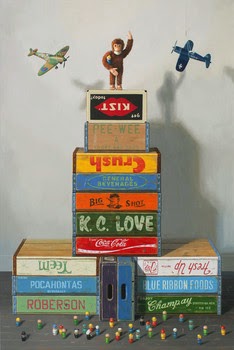
Robert Jackson is represented in the show with another of his whimsical recreations involving wooden product containers. This time a subject has re-created the iconic scene from the movie King Kong using a Curious George doll and a couple model airplanes.  

Bertrand Meniel

Simon Nicholas

Bertrand Meniel captures the ease of a vacation breakfast at The Fairmount while Simon Nicholas captures the collective resolve of commuters at an intersection.

Alexandra Pacula

Kathy Ruttenberg

Alexandra Pacula plays with photorealism by actually blurring her painted images, as if the camera was moving while the photo was being taken. Kathy Ruttenberg shows her versatility by stepping away from her amazing ceramic sculptures to literally represent 5 slices of street scenes. 

Raphaela Spence

Susan Sprung

Raphaella Spence provides an amazing bird’s eye view of Manhattan and an outer-borough while Susan Sprung shows us a thought-provoking and evocative, foggy view of where she used to live.   
  
Each painting in this show works wonderfully in its own way.  Each painting demonstrates that superrealism is not realism.  This type of art brings with it unique emotions for the viewer that other types of painting cannot bring and this work is always provocative.  It is not the type of ‘retinal’ art that Duchamp derided.  These paintings in this show arrest one visually and engage the viewer in a contemplation of transience and permanence as well as a reflection on the current status of New York City as it gravitates to a new mayor and a new era.

Saturday, May 4, 2013

The Super-Realism (Urban Mysticism) of Max Ferguson

There's a fallacy that super-realistic painting is superficial.  Someone was once surprised, for instance, that I liked many of the artists represented by Gallery Henoch (a gallery that specializes in the work of artists who prefer a very realistic painting style). She said, "Dan, I thought you liked art that was challenging and had some meaning to it."

Many people seem to think that in regard to super-realism, the medium is the message.  No; I would say that if you look at Max Ferguson's stuff, it has a kind of urban mysticism the way that Caspar David Friedrich's stuff had a natural or rural mysticism.

I think the key to taking in what Ferguson is conveying is the fact that he always paints people in a super-clean, and I mean super-duper, super super duper anti-septic setting.  Look at this guy on a subway platform.


Folks, if that platform were, indeed, that spotless, the MTA station workers would deserve their bloated salaries.

The anti-septic nature of the environment in Ferguson's work seems to create an even greater sense in the viewer of temporality.  It's the essence of city life - permanence and transition. That station is going to be there years after this guy is dead.

It's better to see Ferguson's paintings at Henoch.  I wish, for instance, I could show you a close up of the guy's face at 34th street.

Here's another example of an anti-septic stage where folks strut and fret their hour:


Yes, that' a painting.

I love this next painting of a man surrounded by books.  Even the overwhelming number of books he has piled in front of him does not disturb the tranquility established through the super-realistic style.

Is this a person who has fled the real work and lives in his books, or is this a person deeply involved in the processes of life searching for an answer?


Here's an elderly man who has stopped by his local (completely sanitized) diner to grab a bite to eat.


And here's a man absorbed in a life without the latest gadgets.


Here are 3 famous paintings by Caspar David Friedrich, who was a German "Romantic" painter of the 1800s.