
After watching Native American medicine men demonstrate sand painting at MoMA, Jackson Pollock felt that his movement over a canvas, while dripping paint, could help to express complicated aspects of his inner reality much more effectively than the semi-abstract symbolism he had been playing with. Action art became a more direct form of mark-making on canvas than searching for visual images and setting them in relation to each other to approximate some inner process or conflict.
Action art is all about immediate and universally recognized mark-making from the inner to outer worlds, and the extent to which we can go back to the marks, later, and recognize them. It is also about how the residue of our lives and actions might influence others as they encounter it. What the limits are in recording expressions, and what the limits are in communicating them, become the big issues in action art. The ultimate goal of this type of art, then, would seem to be to find “perfect” action art that allows one to come back to it later and understand fully what was experienced (for self-reflection and analysis) and to use the markings to affect and transform other lives as the meaning will be clear to viewers.

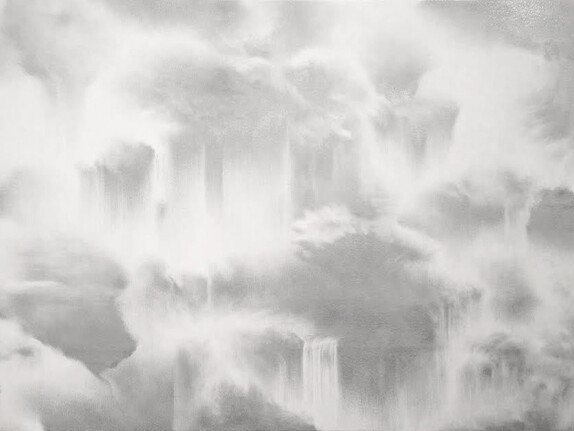
Moon Beom is the most creative, accessible and humane process or action artist whose work I have seen. He eschews any mediating tool between himself and the canvas, choosing to use his bare hands. He will first cover the canvas with one hue of acrylic paint in either a “hot” or “cold” color, then smear an oil stick onto the canvas. He uses his hands, like a masseuse, to rub into the smears left by the oil sticks, creating tenebrous, leafy or tissue-like designs. Kim Foster once referred to the designs as “lettuce-like” and they are clearly vegetative but also with pillar-like or smoke-like elements. Sometimes the “stems” seem to be like rays of light penetrating through clouds. Sometimes the “leaves” seem parched and hanging in space.

These leafy structures are what we engage after Moon’s action or process and Moon seems to be playing with the concept of touch as in touching or reaching or affecting the viewer. It is as if, as a conscientious artist, wishing to use his art to reach and heal and elevate others, he decided to just literally use touch in his art. After all, Michelangelo once said: “To touch can be to give light.” Giving or getting a hug literally reduces your blood pressure. Even a handshake helps reduce stress. Touch eases pain, assists in sleep, reduces irritability, fights depression, lowers stress and heals illnesses, among many other beneficial effects. So Moon is using one of the most humane tools possible in his art – his own capacity to touch.
The choice of colors and relationships between colors in Moon’s work seems deliberate as well. Chromotherapy was a form of healing in ancient Chinese culture. Red, a hot color, was believed to increase blood circulation, while blue and green were seen as soothing anodynes. I think Moon is privy to this and deliberately is using these colors as healing agents, kind of the way Kusama believes her polka dots can heal. So the big question becomes, what are we to make of the leafy structures? Moon uses human touch on his canvas, produces these leafy structures and this is what we engage at the gallery. What does this mean for us? How can we be affected by this?
The best answer would be for you to go plant yourself (ha, ha, pun intended) in front of some of these works at Kim Foster Gallery and get what he gives you. Or, take a look at the images here and see how they make you feel. What is unusual in Moon’s process art is that his “residue” is not abstract like Pollock’s, it is semi-representational but it does not represent anything that truly exists. It is like a Platonic form of leafiness. It evokes a belief in us that we are seeing leafy structures that came about through the compassion and humanity inherent in human touch. We see and feel leafiness, growth, abundance, fullness.

My belief is that most abstraction actually engenders a type of anxiety whether it wants to or not, even if the piece is completed in reassuring and soothing colors. Most people seem to dislike abstract art and will admit that they cannot understand it. I have had educated friends tell me that they do not want to go to MoMA because they do not even want to look at abstract paintings, because those works make them feel as if they cannot get something important. In these works Moon shows his kindness and humanity as well, for he does not leave us with squiggles or indecipherable markings. His process art leaves us with something we can visually grasp, something, perhaps, like a medicinal herb or something mysteriously nourishing.


If you like thoughtful writing that challenges you to think and grow, please read Dan's essays on The Good Men Project: https://goodmenproject.com/author/daniel-gauss/

