Wednesday, December 25, 2013

Super-realism group show at Gallery Henoch

Gallery Henoch, in Chelsea, seems to be the go-to gallery for superrealist painting.  Its current group show of work by 10 artists is called ‘The City.’

Max Ferguson

Hyperrealism, Photorealism or Superrealism (call it what you will) is a resilient trend in contemporary art, which started, in part, as a response to various art movements of the mid-century and 1960s.  Superrealists wanted to assert (yet again) that there was still value in representing the perceived world as it might be captured at one moment in one place.  The difference, however, between superrealism and the realism of Courbet, for instance, would seem to involve the existence of the camera.  Instead of responding to the camera (as other movements did) with contemptuous attempts to do what the camera could not, the superrealists abandoned all pretenses and candidly admitted that the camera and photography does, indeed, exist and that photography can be a legitimate aid or even a starting point in the process of painting.

Max Ferguson

A point many people seem to miss, however, is that neither realism nor superrealism is really 'realistic.'  How, for instance, do we really know a given painting is an exact duplicate of a ‘real’ situation or a ‘real’ photo of a situation?  How do we know that what is represented on the canvas really does exist somewhere?  Actually, we don't and that's probably not the point anyway.  Despite the meticulously detailed style of a superrealist painting, there is, in fact, no real assurance of a correspondence between the painted image and ‘reality.’  What if, for example, a superrealist decided to paint stuff that was never photographed or which never even existed?  It could still be classified as superrealism. Realism and superrealism seem to refer to technique and not to any claims to be accurately representing something that happened or exists in the world.

There is, however, a huge difference between realism and superrealism. The key point would seem to be that in many superrealist paintings, the painter deliberately removes him/herself from the direct experience with ‘reality' that the realist painter often implies.  He/she often starts with a photographic representation of reality and works to make this representation appear ‘superreal’ on a canvas.  Conceivably, a superrealist work does not even have to correspond to a 'real' image.  Surrealism did not have to correspond to real dream images and superrealism does not have to correspond to real, substantial world images.  In fact, in this group show, we see how artsists painting in a superrealist tradition often tweak 'reality' to make it superreality.

Max Ferguson

Max Ferguson’s superrealist/photorealist paintings have always seemed to exude a type of urban mysticism – similar to the mysticism in many of Caspar David Friedrich’s (non-urban) pieces.  The key to getting what Ferguson does, to me, involves realizing that this guy just will not paint dirt or grime.  He achieves his mystical ‘superrealism’ in his paintings through placing people in completely anti-septic environments.  They are often in public places waiting or engaged in a temporary activity.  The pristine nature of the setting (New York City subway stations have never looked so clean) highlights the isolation of the individual and establishes a greater awareness of the divide between the subject and the setting.  This technique highlights the relative permanence of the setting and the transitory nature of the individual.

Richard Combes

In Richard Combes' work we see images of the city reflected in stagnant puddles of water.  So now we are even further divorced from ‘reality’ in that we assume the image was first reflected in a puddle and then captured on a photograph before being painted on a canvas.  

Richard Combes

We also see situations of entropic decay such as his painting of an apartment hallway at a specific address in Manhattan.  We see the second law of thermodynamics in all its splendor as tile is cracked, wood is exposed and paint is rotting on some woodwork.  Interestingly, though, although the hallway is in a state of disrepair, it has been swept and mopped.  The empty chair can represent a type of languor or apathy toward making more than a perfunctory effort at really fixing the situation.  

Vincent Giarrano

Vincent Giarrano presents young women in transition, interesting but inaccessible, chatting on their smart phones, placing calls or just waiting and thinking.  
Robert Jackson

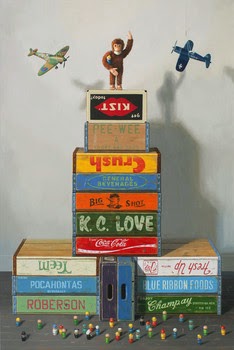
Robert Jackson is represented in the show with another of his whimsical recreations involving wooden product containers. This time a subject has re-created the iconic scene from the movie King Kong using a Curious George doll and a couple model airplanes.  

Bertrand Meniel

Simon Nicholas

Bertrand Meniel captures the ease of a vacation breakfast at The Fairmount while Simon Nicholas captures the collective resolve of commuters at an intersection.

Alexandra Pacula

Kathy Ruttenberg

Alexandra Pacula plays with photorealism by actually blurring her painted images, as if the camera was moving while the photo was being taken. Kathy Ruttenberg shows her versatility by stepping away from her amazing ceramic sculptures to literally represent 5 slices of street scenes. 

Raphaela Spence

Susan Sprung

Raphaella Spence provides an amazing bird’s eye view of Manhattan and an outer-borough while Susan Sprung shows us a thought-provoking and evocative, foggy view of where she used to live.   
  
Each painting in this show works wonderfully in its own way.  Each painting demonstrates that superrealism is not realism.  This type of art brings with it unique emotions for the viewer that other types of painting cannot bring and this work is always provocative.  It is not the type of ‘retinal’ art that Duchamp derided.  These paintings in this show arrest one visually and engage the viewer in a contemplation of transience and permanence as well as a reflection on the current status of New York City as it gravitates to a new mayor and a new era.

Tuesday, December 24, 2013

Shoja Azari at Leila Heller Gallery

For some time now the Leila Heller Gallery has been adding an important element of diversity to the Manhattan art gallery scene.   Since 1984 Heller has been regularly showcasing emerging and established Middle Eastern artists and continues to do so with the current show: New Works by Shoja Azari.


Surprisingly, not many Americans know that the current map of the Middle East was, basically, drawn by the British and French after World War I.  The Ottoman Empire had controlled a wide swath of the Middle East, but after its loss of territory in World War I the English and French merely drew lines across a map and divided the territories according to what they wanted, not by geographical features or by which ethnic group was living where.  The nation of Iraq was, for instance, a random construct made from what had been a big chunk of the Ottoman Empire.

Shoja Azari's work seems to imply that, to the West, the Middle East has always been earmarked for colonization or exploitation due to an unrealistic conception of what exactly is over there.  In fact, he would seem to drop lots of the blame into the lap of European artists from the 19th century who picked out the most exotic elements of the Middle East and constructed a fairy tale narrative out of the place.  To 19th century European artists the most salient features of the Middle East were the harems, dancing girls, the odalisque and the varieties of drugs and dissipation available to European tourists.


Shoja Azari ironically comments on how history has changed this narrative.  The narrative has changed, however, it remains far from the truth.  In his show, in the repainting of the 1870 French painting “The Snake Charmer,” we see the introduction of rocket launchers.  In an update of Delacroix’s “Fanatics of Tangiers,” we see a mob burning an American flag.  In “Oriental Bath or Bunnies R Us”, overtly pornographic elements are added to the type of “Orientalist” painting that first misrepresented the Middle East.  Azari seems to be implying that in understanding 'weaker' or 'third world' foreign cultures we often use a binomial language of sex and violence.  Even if those two elements are not really pervasive in the culture, we like them so much that we stick them in there anyway. Indeed, let me delve into the controversial by saying that Azari might have even said we get this binomial sex/violence orientation to weaker cultures from the Bible, where God routinely ordered the destruction of foreign cultures based on a narrative He allegedly provided to those doing His will in the Middle East.  Azari does not say this, however. 


Interestingly, Azari did not paint these satirical works.  He commissioned painter Karl Koett to reproduce the works with the modern elements thrown in.  On the walls of the gallery next to the commissioned paintings you see contracts between Azari and Koett for the works.  Whereas 19th century “Orientalist” works were gobbled up by wealthy art buyers who wished to buy into a misrepresentation of a culture, Azari seems to be saying that the current art buyer likes gobbling up irony.  The modern, educated, sophisticated buyer wants to feel that he is in the advance guard, privy to the most recent and progressive social revelations.  To mock those who don’t get “Islamic culture” is cool and such work can be commissioned and purchased.  To help the viewer get this idea in a more limpid manner, surrounding the commissioned paintings is a type of wallpaper made of teeny-tiny little images a person gets from ‘googling’ the word “terrorism” or "suicide bomber" etc. 


The real treat of Shoja Azari’s show, however, is the amazing 24 minute videotape that he made based on a story by the Persian poet Nizami Ganjav.  Ganjav wrote an epic poem in 1197 called Haft Paykar (Seven Beauties).  Apparently this was a poem more influenced by Zoroastrianism than Islam (The Zoroastrian religion contributed greatly to Judaism and Christianity but the religion has, for the most part, died out – it was replaced in Persia by Islam - except for some contemporary followers in India who call themselves “Parsis” or Persians).  The poem is an allegory on developing greater self-awareness as a means to attaining moral and spiritual perfection. 

Azari takes one tale from this poem and creates a vivid and sensuous short video called The King of Black.  In this video a King learns of a land where the people are continuously sorrowful and dress completely in black.  He journeys to this land to discover what has happened and, while there, is introduced to various kinds of pleasure, especially sensual pleasure among a group of women introduced as houri.  Houri are, of course, familiar to western Islam-bashers as the heavenly courtesans who will allegedly provide pleasure to men (especially martyrs and suicide bombers) in the after-world.  While experiencing the pleasures which the houri can provide, the King indulges to excess and is banished into the land of sorrow, where he adopts a black garment and becomes the King of Black.

The process of mourning in the video is, however, seemingly equated to suicide bombing.  In the video we see a woman dressed in black mourning her son while gazing at the type of photograph made by a suicide bomber before his death. Indeed, numerous of these women sit in a desert lamenting their losses when the King passes through this land. The allegory on spiritual perfection is, therefore, reworked into a contemplation of the putative rewards of martyrdom vis a vis the human suffering caused by such an action.  The paradigm of a heavenly paradise becomes the lure to violence instead of an ideal to achieve peace.  The desire for concupisence, the promise of sexual rewards in exchange for random violence, leads to a land where all suffer and grieve. 


Sunday, December 22, 2013

Mary Frank's clay sculptures at DC Moore Gallery

{click on images to enlarge}

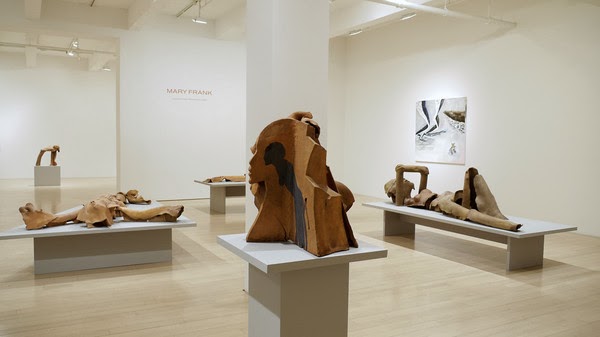
The Chelsea art galleries in Manhattan are an amazing free public resource and the DC Moore Gallery helps to show why with their latest show - Mary Frank: Elemental Expression (Sculpture 1969 – 1985 and Recent Work).


In the press release for the show, Frank is quoted as saying: “Clay is gravity seeking. There are moments when it seems analogous to flesh.” She also states: “It is an astounding medium…so alive and dead, both.” Frank’s innovation involved how she used clay to represent her figures. Using clay’s flesh-like qualities, she created sheets of this material to form an outer layer of a figure’s body. Furthermore, she made no attempt to make the sheets seamless. Indeed, you often see intentional gaps between the sheets and you often see where the sheets of clay overlap. The result is that you perceive hollow figures of (mostly) women who were engaged in intense emotional or inner experience. The hollowed pieces seem to represent the residue, as it were, of the inner change or intense experience that occurred. This is, basically, petrified evidence of inner engagement that we are challenged to now engage and understand. The pieces often seem to capture a moment of inner change leading to tranquility or some intense bliss or serenity being directly experienced by the figure.

In many of her early works on display at DC Moore, we see these figures lying supine while having engaged in some trying type of inner process. The position of the body often implies that some type of struggle has occurred within the resting body. In other pieces we see figures upright and dancing or in some type of extreme, gravity-defying posture. By presenting the outer crust of the person undergoing intense experience, Frank seems to be pointing to the divorce between that transformative outcome within the figure and the perception of and attempt to understand what has happened by the viewer.


In these sculptural pieces, the viscera of the subject are gone and this is, basically, the de facto case any time we perceive another person undergoing something intensely emotional. We are compelled to interpret and respond to what we can see – we have no direct access to the actual feelings of the other person. If another is feeling pain, we often will also feel pain, but it is a different type of pain. Our bodies and emotions essentially deceive us with analogous but watered-down versions of the other’s experience, which does tend to draw us closer to the afflicted person, but not enough for a real sense of fellow-feeling. Conversely, when we see extreme joy, we also might feel joy, but it is not the joy the other feels, but a diluted version that intimates the deeper joy while still excluding us from the full participation that only the subject who has engaged in the initial experience can feel.


In these pieces by Frank, these are frozen, petrified experiences without the external or internal contexts. We do not know what initiated the experience and we do not know the inner workings of the body that brought about the experience. We are left with nothing but the physical expressions. Indeed, we are very much interlopers and voyeurs in this process. The figures are not attempting interpersonal engagement with us – they have sought out seclusion and we have found them, or at least found traces of what they have gone through.


Others who have seen Frank’s work point out a sensuality in these figures. That’s true but in some religious literature and art (St. Theresa by Bernini is an easy example) sexual ecstasy seems to be used as an analog to approximate complete spiritual fulfillment. It is the closest form of corporeal bliss that can approximate spiritual bliss. Religious writers and artists (including Frank) might also be pointing out the intense relationship between the spiritual and the sexual. The spiritual is literally born from the sexual and also gives meaning to the sexual process.


More than anything, Frank seems to want us, perhaps, to be aware of the distance between experience and the perception of experience, and to examine how we face this distance. How do we grasp, or can we grasp, what these figures are experiencing? Do they elicit compassion? Do we feel joy? veneration? envy? curiosity? Do we really recognize what the subject is going through? If we have not experienced intense, spiritual ecstasy, for example, but we are confronted with evidence of it (in these pieces), what is our response? Can we even believe in the experience that these figures seem to have gone through? Do these figures give us hope for something more meaningful in our lives or are we left with a feeling of disbelief?
DC Moore also presents more current work by Frank done through the process of archival pigment printing on bamboo paper. In the vibrant pieces Frank further explores the themes of experience, transformation and transcendence which are found in her sculptures.

Tracey Moffatt - Australian artist shows new work at Tyler Rollins Fine Art

{{{click on images to enlarge them}}}

The Tyler Rollins Gallery, in Chelsea, focuses primarily on emerging and established artists from Southeast Asia. Since the mid-2000s they have done a yeoman’s job of presenting amazing art work which otherwise might have been overlooked in America. Tyler Rollins Fine Art’s latest show extends a bit beyond its usual geographical parameters to feature the work of a world-renowned Australian artist (of Aborigine descent) who deals with issues surrounding the troubled legacy of Australian/Aborigine relations and how she and others have been impacted by and have even overcome this legacy.


Some historical background can help the viewer better appreciate the work by Tracey Moffatt in her “Spirit Landscapes” show.

After the English arrival in New South Wales (Australia), the English Governor issued an 1835 proclamation that, before the arrival of the English, the land of New South Wales had belonged to ‘no-one’. This was followed by a softer proclamation declaring that Australian land could not belong to anyone without the consent of the colonial government. A legal declaration that the land on which Aborigines had lived for tens of thousands of years truly belonged to them was not issued until the Mabo Case of 1992.

Like Native American ‘Indians’ Aborigines died in huge numbers from European-borne diseases and their hunter-gathering clans were forced off of land that they needed for their survival. Aborigines who tried to resist were slaughtered (aborigines who didn’t resist were slaughtered as well) and many were forced into slavery and prostitution. Ultimately, the Australian government decided on an ‘integrationist’ approach. This, unfortunately, led to the ‘stolen generation’ (from 1910 – 1970) - the fact that 100,000 aboriginal babies were literally taken from their mothers and placed in white families. 1% of the Australian population is currently Aborigine and about half live in towns (usually in ‘slum’ areas) while others have tried to return to their original lifestyle. To this day Aborigines are routinely subjected to racism, discrimination and violence. The Aborigine population suffers from high rates of alcoholism and the Australian prison population has a disproportionate representation of Aborigine men.


The show “Spirit Landscapes” constitutes one of the first major shows by Moffatt after she returned to Australia after twelve years in New York. This theme of returning home is best embodied in Moffatt’s “As I Lay Back On My Ancestral Land” series. In these photos we see that Moffatt lies supine on the ground that allegedly had belonged to ‘no-one’ until the English found it. In the process of resting again on this land, her body seems to engage in a type of levitation in which it and the sky visually merge. These are visually arresting and beautiful images. In allegorical literature and art, spiritual fulfillment is often expressed through some type of union – the masculine and feminine, the active and passive etc. What’s unique here is that the union that denotes a type of spiritual fulfillment is between the human body and the sky. As I Lay Back On My Ancestral Land #2 seems to show this most clearly.  Moffatt seems to abandon the traditional Western concept of spiritual union for a more elemental concept in greater harmony with her people’s legacy and traditions.


In the stories of the “Dreamtime,” when the original inhabitants of Australia were created and placed on their land, the dreaming creators literally sometimes changed themselves into the places people inhabited. People who belong to an area are also literally part of the area as well. The effect of merging the body and clouds within a monotone hue, so that the curves of both the body and the clouds are sometimes hard to distinguish from each other, gives a sense of deep fulfillment. Perhaps it is the serenity of the traveler who has come full circle and has embraced the meaning that the colonizers of her land were never able to fully extinguish.


In ‘Suburban Landscape’ an apparently innocuous image of suburbia takes on a more ominous interpretation through the crayon stenciled description Moffatt places over the photo. “BULLIED HERE” represents a deeply embedded association between this spot – a sidewalk leading past a house - and an act of cruelty which happened to the artist. There are, however, more cheerful photo descriptions showing that along with the challenges of an aboriginal childhood among the dominant culture of Australia there are moments of innocence and joy. 

We see: CROSSED THE CREEK and TOSSED FLOWER PETALS, for instance.


"In and Out’ shows stills of figures at the entrance of a mining town brothel, where, presumably, aboriginal women are forced to provide pleasure for the miners. In “Picturesque Cherbourg” we see the settlement where Moffat’s own family was forced to relocate from their ancestral lands. The images are of beautiful middle class surroundings including neatly maintained houses and lavish gardens. Yet, on closer inspection, we see many of these images have been torn and placed back together.  Perhaps the rage toward these images comes from the fact that so many people succumbed to the life offered to them by the Australian government, or that they had no choice but to try to integrate. The torn images could also represent anger generated by the simple fact that the Aborigine population was forced to try to integrate but never, in fact, allowed to fully integrate.


“Pioneer Dreaming” presents images of famous Hollywood actresses in various Western movies which glorified the pioneer spirit and demonized the American Indians. The women look confidently and heroically out over the land they will soon unequivocally possess. Finally, in “Night Spirits” Moffatt drives deep into the outback, late at night, to areas where the Aborigines once, perhaps, hunted, and takes photos in the absolute darkness there. Photographing into the darkness resulted in ghostly shapes and images on the photo over otherwise benign highway or street scenes. These shapes and images can visually represent the true horrors that took place on aboriginal land and which can still be sensed and even captured, if one is willing to directly address the largely unaddressed tragedy that has occurred to the indigenous people of Australia.

Monday, December 16, 2013

Kelly Reemtsen - America's Sweetheart - at De Buck Gallery

click on images to enlarge them

In the early 1990s Naomi Wolf published The Beauty Myth.  In this work she pointed out what she felt to be an alarming paradox for contemporary women in America.  Although women had been gaining greater and greater equality and power in American society, to Wolf, they seemed to be more miserable than ever before. 

Wolf cited various psychological problems faced by contemporary American women and stated that accompanying woman’s rise to equality were eating disorders and an exploding plastic surgery industry. 

Wolf’s conclusion was that even though our male-dominated society was giving in to demands for equality, it was tightening its demands for an even greater femininity.  It was a bizarre quid pro quo agreement: we’ll give you freedom and power if you become sexier than our deepest fantasies.  

Wolf portrays the contemporary woman as mired in this paradox and speculates that the contemporary woman, with her freedom and power, may be more miserable than her house-bound grandmother.  After all, the contemporary woman (according to Wolf) was always trying to meet the impossible beauty goal (myth) established by men.


It’s interesting to think of the recent work of Kelly Reemtsen in light of this work by Wolf.  In Reemtsen’s current show at De Buck Gallery she, for the most part, only focuses on the middle portion of a woman’s body.  We can see that the trim and toned woman is beautifully dressed in vintage clothing and often wearing various accessories.  The woman is also often carrying some type of heavy tool, like a chainsaw or an ax. 

The chain saw or ax, however, is also, often, at least partly colored in pink.  The woman has seemingly embraced and feminized these various household and gardening implements.  Are these women, basically, what Wolf described - women who can handle men's jobs but who must also be super-feminine? The tools are no longer even male tools to these women, although we, the viewer, might find something out of kilter here. 

Indeed, as the notes for the show point out, there can be an ominous interpretation to these works of women carrying long axes and chainsaws – they don’t just provide the women with the capacity to do various odd jobs around the backyard.


Interestingly, Reemtsen also presents a series of pill sculptures which are displayed in a window of the gallery.  These are the pills typically associated with the psychological problems stereotypically associated with women.  Prosac, valium etc.  The pills are much larger than in reality and almost look like corporate logos or attractive product brands. The actual physical design of each pill is highlighted and shown to be a deliberate attempt to be attractive to the user. There is a design principle behind each pill.  

Is Reemtsen buying in to the Wolf argument, then?  Is she concurring that there is an unresolved dilemma for most contemporary women and that the quickest and, indeed, only cure would seem to be these drugs specifically tailored to professional women?


It sure looks that way, yet the show could also be a type of rebuttal to Wolf.  It’s impossible to see the faces of the women who are carrying the various tools, so we really don’t know whether they are happy or not.  Perhaps Reemtsen could be implying that the desire to be powerful (holding a chainsaw confers some power) does not, in itself, negate a desire to be feminine.  When I read the book by Wolf, long ago, I found it hard to believe that men could be so sinister (or so clever) as to offer such a Mephistopholean deal to women (‘We’ll give you worldly power if you look and dress sexy!’).  

Perhaps she is saying women never bought into a quid pro quo with the ‘patriarchy’ – maybe the desire to be feminine was a self-choice.  Wolf, herself, does not wander around the world in Chairman Mao or Kim Jung Un attire. Maybe women sought power and femininity at the same time.

In any case, Reemtsen’s work, In its deliberate ambiguity, gives the viewer a great deal to mull over.  Are these women victims who, by decorating their work tools pink, have internalized and embraced their victimization, or are these ladies the proud and liberated victors of a long struggle?  Or, are they somewhere in between? 

Read the essays of Daniel Gauss at Good Men Projecthttps://goodmenproject.com/author/daniel-gauss/

Thursday, November 28, 2013

Kris Kuksi at Joshua Liner Gallery

What is a Kuksi churchtank? The caterpillar tracks and the hull are two basic components of a military tank, and they are present, but, in place of a full turret (which is normally transported by the hull) Kuksi has placed a church edifice.  Indeed, the edifice of the church sports the main gun of the tank, which seems to emanate from a central narthex door of the church.

{{{click on images to enlarge}}}
What does a Kuksi churchtank mean? 

One interpretation could be that the hull and gun represent our aggressive, animal nature: what Schopenhauer called our Wille zum Leben (a will to live and compete).  The church edifice might then represent our higher nature, a “spiritual” nature, which can either temper or release the aggression beneath it.  The main gun or cannon seems to be at the crux of this vehicle – the one element shared by the hull and church-turret.  One could say we are all little church tanks treading our way through the world each day.   

However, thinking more geopolitically, a big implication of the church tank is that, in the real world, the forces of spirituality rarely temper the more aggressive churchtank features.  Kuksi, himself, explains that he created the churchtank series because he felt that the church seemed more interested in stifling other beliefs, religions and cultures than in promoting the core values of the Christian religion as preached by their putative founder.

The USA is, furthermore, 80% Christian.  We have recently engaged in two wars against Muslim countries.  George Bush called himself a Methodist and a born-again Christian whose alcoholism could only be tempered by the miraculous love of Jesus.  He also liked using the word “crusade.” Kuksi seems to ask to what extent the Christian religion guides our foreign policy on a conscious or unconscious level.  As David Halberstam pointed out, the guys who started and messed up the Vietnam War were all dyed-in-the-wool White Anglo Saxon Protestants who knew nothing about, nor cared to know nothing about, Asian culture. 

Kuksi asks: to what extent does the church become a validation for the military and to what extent does the military prop up and support the church.  For instance, I would be remiss not to point out that the current Pope had a position of some responsibility during Argentina’s “Dirty War” and not only did not speak out against the murder of students and dissidents, but befriended folks from the murderous junta.


In Kris Kuksi’s work at Joshua Liner we also see what would seem to be idealized godlike images contrasted, yet connected to, in some manner, surrounding images of military preparedness or outright battle.  


My first take on this was that the artist might be interested in the paradox of the extent to which only terrifying weapons and various types of military deterrence can create possibilities for peaceful spiritual pursuit.  After all, Chairman Mao showed the people of Tibet that you cannot pursue your religious goals unless you have an army to protect those goals. 


Is Kuksi saying there can be no pacifistic spiritual quest outside of a society that does not protect your quest with a zillion dollar weapons industry and military complex?  According to this interpretation, the god-like beings in Kuksi’s work are ideals of spiritual perfection and the surrounding soldiers make that perfection possible.  Yet, it could also be that the ideals and godlike idols are the ones generating the warfare.  One of Kuksi’s pieces is, after all, called Neo-Hellenism, and possesses a central Helen-like figure around which military conflict conflagrates.  


Tuesday, November 26, 2013

Yoko Ono's Wish Tree at Jim Kempner Fine Art in Chelsea


My friend Yunhee took a couple really good photos of Yoko's "Wish Tree" at Kempner. 

I just learned, by the way, that Kempner also has created a very funny video series about what it's like to run a Chelsea art gallery.  www.themadnessofart.com   It's worth watching.  


To ancient societies trees held symbolic and even magical power. A tree was like a bridge between the earth and the sky. The roots of a tree penetrate deep into the earth and derive sustenance while the trunk rises and branches reach into the air. So even today a tree can be thought of as a type of bridge between the earth and the sky, or a bridge between the ‘lower’ and the ‘higher’ or our animal nature and our godly/spiritual nature.

On her website Yoko Ono explains that as a child she would go to a nearby temple and, like others, tie wishes written onto little strips of paper to a tree branch. The trees in the courtyard of the temple often held numerous of these wishes from her community. Indeed, Yoko has been facilitating the replication of this process since 1981, around the world, and she has been keeping all of the wishes that people leave on her “wish trees” for an Imagine Peace Tower. She currently has such a wish tree at Jim Kempner Fine Art in Chelsea.

When I was passing by Kempner recently, I saw a small group writing out their wishes and tying them to the tree’s branches and I was, frankly, affected by the sincerity of the act. People were earnestly hunched over or squatting on the ground scribbling onto a little sheet and then looking for space on the tree where they could hang their wishes. So although many people feel intimidated by contemporary art, or say that they don’t like modern art museums because they don’t understand what the artists are doing, Yoko has found a way to really engage people, through art, in a deep and significant manner.

By inviting people to make a wish and to place it on a tree branch, she compels the viewer/participant to really focus on what’s central to his/her life and determine whether this is as meaningful as it should be. Some people have written frivolous things, some people make political statements (I saw: “Down with the patriarchy!” written on one slip) but many people express thoughts directed to others who are hungry, homeless, impoverished, suffering injustice/cruelty or in need of some type of assistance. Of course, after making the wish, the participant is also tacitly invited to question what exactly is stopping this wish from coming true. Is it political? economic? racial? Each person is invited to reflect on the extent to which he/she can and cannot take action to make this wish a reality. Each person is, in fact, invited to begin to take action again, on whatever level, to spread peace and justice throughout his/her community.

Trees may have lost their magical power in our post-industrialized, secular world, but they still retain their symbolic power. The Wish Tree therefore represents the latent good will in all of us to wish each other goodness and prosperity, as a first step to finally bringing about a truly humane and conflict free global community. Who knows, this could be a magical process after all.