Showing posts with label art blog new york city. Show all posts

Monday, February 8, 2021

Desire as a Self-Contained Environment - BD White at Castle Fitzjohns, Lower East Side, Manhattan (October, 2017) Originally in Wall Street International


In allegorical literature, ‘coming home’ often meant the union of masculine and feminine that brings peace and stability. In the ancient world men were generally active and women were generally passive (due to social expectations and constraints) and this provided the substance for this type of symbolism. The active male became symbolic of a desire for something higher or more pure while the passive female represented the fulfilment of that desire accomplished through the male quest, battle or journey. This can be seen in such stories as Rama/Sita, Odysseus/Penelope and even Tamino/Pamina in the Magic Flute. 


Perhaps there is no more extreme or salient contemporary example of leaving and returning home than that of the astronaut’s journey. In his current show Love, Loss and Longing at Castle Fitzjohns, BD White plays with the concept of astronaut as it relates to his personal life and lost love for a woman but, to me, the show is also an absurdist Bowie-like, Major Tom-take on the greater theme of union or failed union between the masculine and feminine that has dominated aspects of our art. 


The astronaut is a quester who literally leaves the safety and warmth of his/her planet for a higher goal in the void of space. He/she must replicate a basic artificial and self-contained, though unsustainable, environment consisting of heat, breathable air and a suitable air pressure. He/she becomes alienated from both the earth and space through the life-sustaining mechanism he/she wears. The astronaut literally enters a void and can experience extreme isolation where one might be forced back on one’s own (painful) memories instead of dealing with new experiences. It might be like sitting under a bodhi tree for 40 days. 


Indeed, the astronaut journeys into the ultimate hostile environment – the ultimate desert. Jesus was called into and fasted for 40 days in a desert before this process of isolation and self-denial changed him to the extent that he could pass the three tests of Satan and enter the world as an agent of transformation. The astronaut in the work of BD White, floating in his tin can, floating in the void, represents our contemporary symbol for desert transition and transformation – to me at least. In some of his depictions of his astronaut, we see postures of ecstasy, abandonment, being lost and/or liberation.


Yet, the space suit with its artificially self-contained environment also represents our act of will – our way and our choice to explore what should not, apparently, even exist in the first place (How could something come from nothing? How could something always be?) without any real hope of getting to the real answer of how the universe came into existence. As Augustine, Luther, Calvin and a host of others have argued, salvation is not something that can be chosen or pursued as a goal. It is something that happens through Divine Grace and mercy. When we choose to be ‘saved’, a Catch 22 kicks in, and we fall short. Our own will can never lead us to the fulfilment dreamed of in allegorical literature and its many quests and conquests.
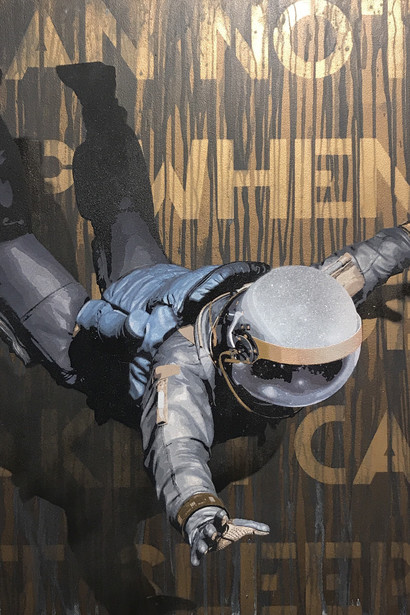

So in the works of BD White, we see this impossibility of union which is brought about through the spacesuit. What if, in our self-chosen quest, painful memories and reflection on them do not change us? What if we recognize and feel social shame toward, but cannot truly detest and overcome, our sins? What if we cannot reach the ‘ex ante’ and are left wallowing in the ‘ex post’ of unwanted emotional and behavioral responses? This leads to the absurdist comedy where the astronaut can see the woman, can ostensibly desire the woman, can have some contact with the fulfilment of a desire to return home but realizes an incomplete homecoming and this becomes the true reality of his quest…the circuit’s dead, there’s something wrong. The quest is kept alive but the possibility of consummation is rendered impossible. In his attempt to create imagery to capture and convey the inconsolable emotions involved in a difficult break-up, BD White also touches upon one of the most commonly used literary and cultural themes, pointing toward the difficulty of abandoning a self-destructive will to accept real deliverance.


Friday, October 27, 2017

Sisavahn Phouthavong-Houghton: Recalling the 'Secret War' in Laos

Agent Orange

{{{click on images to enlarge them}}}

Few Americans realize that, even before the Vietnam War, the United States was involved in a horrific military conflict in South East Asia. Indeed, during the 1960s and 1970s Laos became the most heavily bombed country in the history of the world (260 million bombs were dropped, of which 30% did not immediately explode). Bombing campaigns funded by the U.S. on behalf of the Laotian government and Soviet military support of the revolutionary Pathet Lao displaced more than 1 million people in a country of 2.5 million, in a civil war that would ultimately be won by the Pathet Lao.


UXO - Laos
To this day Laotians suffer from the effects of this war – 20,000 people have been injured or killed from explosions of previously unexploded bombs (50% of them children) and babies are still born with physical and cognitive disabilities due to Agent Orange. The country remains severely underdeveloped (75% of the 6.7 million citizens of Laos are either poor or subsistence farmers). Laos was the first domino to fall in a situation that did not yield the cataclysmic results for international freedom and capitalism feared by President Kennedy; yet, the adverse results for the people of this country have been substantial and long-lasting.


Ho Chi Minh Trail
Sisavanh Phouthavong-Houghton recently had a show at Tinney Contemporary Gallery in Nashville, Tennessee dealing with the legacy of this war. Phouthavong-Houghton’s father was targeted by the Pathet Lao for execution, as a doctor working for the American-funded Red Cross, so he escaped with his family from Laos through Thailand, finally coming to the U.S., being accorded asylum by the U.S. government. In the USA, to support his family, he was forced to do factory work for the rest of his working life. Phouthavong-Houghton arrived as a 4 year old refugee with her family, is now married with two daughters and is Professor of Art-Painting at Middle Tennessee State University, Murfreesboro, Tennessee.

Legacies of War

Phouthavong-Houghton had wanted to address the issue of the Secret War in her work and had gone as far as attempting small works based on drawings made by the victims of the bombings, but this never worked out to Phouthavong-Houghton’s satisfaction. A turning point and impetus to finally address this topic, head on, came after she met Channapha Khamvongsa, founder of Legacies of War, at the LAO Writer’s Summit in May of 2016 in San Diego. The genesis of this current series derived from how Houghton was affected by the sharing of her Laotian heritage with numerous other Laotian professionals passionate about a cause meant to help the Laotian people, even though most at the conference had been raised outside of Laos.
Lost Chronicle

Phouthavong-Houghton told me, “This work does explore the challenges of being a refugee and an immigrant, no doubt about it, from the gestures, movement, hard and soft edges, imagery and traditional Laotian colors.” Her current work, to me, represents both a fragmentation of landscape and experience due to the imposition of a type of utilitarian logic which justifies cruelty and brutality in the pursuit of dubious political ideals.
Ho Chi Minh wanted a unified country and was willing to take massive loss of human life for that ‘greater end’. The Pathet Lao gratefully accepted North Vietnamese aid to create a horrific civil war to bring a type of socialism to Laos which has limited the country’s participation in the global community. President Kennedy feared that Asian countries would fall to Communism like dominoes and supported a massive bombing campaign in Laos at the same time he propped up a corrupt government in South Vietnam. Lyndon Johnson faked a crisis at the Gulf of Tonkin to convince the Congress an escalation of war was necessary.


Plain of Jars
Everyone had a reason to displace and slaughter hordes of people who wanted nothing but to live peacefully with their families. Phouthavong-Houghton’s work is, therefore, relevant for today in that this same type of logic is still applied to foreign policy decisions yielding the same inhumane and unacceptable results. Was it really necessary for the US to support a civil war in Syria which has led to 400,000 dead and another refugee crisis? 12,192 bombs were dropped by the U.S. in Syria in 2016. Did our leadership attempt any novel or humane solutions, or did they just resort to this same type of anachronistic approach, which always seems to yield inhuman and barbaric results?
If we look at the best anti-war art, we see a lot of what Phouthavong-Houghton is doing, with the big difference that she has had the courage and integrity to take the next step straight into pure abstraction, leaving explanatory figuration for the abstraction behind. While looking at her work I realized, for instance, that if we look at David’s Oath of the Horatii, a strong anti-war piece, it is dominated by sharp, piercing angles formed through the three dangling swords and rigid arms obliquely elevated in a pledge to engage in senseless battle. We see this piercing fragmentation as well in, for example, Otto Dix’s Das Geschütz (1914), in which he presents a massive piece of German artillery (looking like a converted piece of industrial machinery) surrounded by acute abstract patterns.


Resilience
Interestingly, Kandinsky’s Improvisation #30 (1913) is not pure abstraction either, in that it presents two canons in the lower right corner as the source for a crumbling of figuration in the apparent depiction of a battle affecting a city and a group of people. The war pieces by Leonard Rosoman and Paul Nash sometimes have this characteristic splintering and rending of figuration through recourse to figuration, which we also see in the ultimate piece of anti-war art – Guernica. These are the cold, sharp, shattered, disunited angles generated by the type of logic that is continually employed to wreak destruction on populations for an allegedly higher end.


Unthinkable Randomness
While discussing this, Phouthavong-Houghton commented, “Yes, it seems fitting that you bring up Picasso’s Guernica. The tension, broken up planes and abstracted figures is similar to the way I am working with landscape. Also, my hope for the viewer is that even if he/she does not know anything about art, the viewer will get hit in the face with bright colors, chaos, movement, confusion, become discombobulated because that is how my family and all refugees and immigrants feel when they move to a country where they don’t speak the language, know the terrain or even the culture. Most step into darkness hoping to find their footing and a path that will lead their kids to safety, hope, and opportunities they could not provide them in their own native war-torn country.”


Saturday, July 11, 2015

Ray Bull impugns abstraction at Ana Cristea Gallery in Manhattan

{{{click on images to enlarge them}}}

When looking at a representational work of art – a piece that represents stuff and/or illusionistic relationships between stuff in the world - there’s a tendency to engage in a specific cognitive process that might not allow for a meaningful experience or full engagement with the piece (Susan Sontag, of course, wrote about this in her essay “Against Interpretation”). 


There is also the tendency to resort to an easy allegorical interpretation based on what we believe certain traditional ‘symbols’ in a piece might mean. So if we look at Rembrandt’s “Polish Rider” at the Frick we might verbalize something to ourselves like: “The horse in this painting is clearly a symbol of the means of transition from one state of being to another.” In this case one’s engagement with the piece seems sorely limited through that process of analysis, realization and verbalization. The purpose of abstraction was, in part, to subvert this interpretive proclivity and allow the viewer to be more deeply engaged through forms and colors and the relationships between them. That was the theory anyway. 


The work of Ray Bull at Ana Cristea Gallery openly impugns the autonomy of abstraction. In the notes accompanying the show it is stated that, “Ray Bull’s paintings speak to the impossibility of abstraction in painting. His compositions consistently straddle the line between representation and abstraction.” So basically Bull seems to be implying that when you look at a work of abstraction, in order to get anything from it, you engage in, basically, the same thought-processes that you use for a representational piece. 


Abstraction is allegory by another name in which you bring the same preconceptions and pre-existing beliefs to the work as you do with representational pieces and subject it to analysis. There is no way to move beyond this analytical process and to believe there is a way to be affected by abstraction without cognitive analysis becomes tantamount to believing, a la Carl David Friedrich, that staring at mountains long enough will integrate you into nature and help you feel the true Christian God. Being directly engaged, without analysis, by a piece of abstraction, is a myth.


Ray Bull also, in his pieces, seems to take this argument one step further. He seems to want to get at the source of our capacity to verbalize meaning and how a type of destructive interpretive feedback loop can be created through this process. If I look at a work of abstraction and can analyze it, it is due to the relationship and effect of the various elements in the painting. It seems that the awareness of the relationships between colors and forms and their effects then inevitably leads to a need to articulate or verbalize which then destroys any further capacity for direct engagement.  


Once one becomes ‘aware’ of what the piece is doing, or how a piece affects one, the real meaning of the piece is destroyed. Indeed, the tension between abstraction and representation in Bull’s pieces points to the fact that in the very process of creation of abstraction, if analysis occurs by the artist, true abstraction is destroyed. In attempting to create an abstract piece analysis of the relationships between colors and forms will, however, occur and, of necessity, the piece will lose its vitality and potential for engagement and merely invite a limited cognitive interpretation from the viewer.


So Bull’s pieces show abstraction in its flawed reality. Yet, Bull could also be pointing to the fact that a ‘real’ type of abstraction might be possible. By extension we can guess that if an artist chooses pure, unadulterated improvisation, true abstraction might be possible and true engagement of the viewer might occur. Yet, Bull could also be saying that in the deliberate choice of improvising there is also analysis and planning, which would then militate against the ultimate goal.

Ray Bull
Get Up With It
June 18 – July 17,2015
Ana Cristea Gallery
521 West 26th Street
New York, NY 10001


Daniel Gauss


Tuesday, May 5, 2015

Reza Aramesh - "Friday April 25th, 2003 at 7:55am" - at Leila Heller Gallery

{{{click on images to enlarge}}}

Iranian-born artist Reza Aramesh’s work has not just explored issues of inhumanity, cruelty and suffering (based on images from the popular press), but, to me, has also deeply questioned the extent to which the visual arts have attempted, throughout history, to even acknowledge issues of human suffering. Indeed, in his approach to depicting victims of war he seems to question whether visual art can even adequately address the compelling issues of oppression and horror given the financial basis of the whole field.

Throughout his career Aramesh has regularly taken images from the popular press of individuals who have been captured in war or military occupations and he has ‘decontextualized’ the victims. Basically he removes the victim from the context of his capture – you see the victim alone, in a posture of subjugation, and as the victim is often naked or semi-naked, you are not even aware of the time frame of the capture, abuse and humiliation the prisoner is undergoing. Aramesh also adds a little twist by referencing iconic images of religious suffering in his sculptures. One might be reminded of Bernini, Velasquez, Caravaggio, Reni et al. as one looks at Aramesh’s pieces. He has also employed actors in the past to create types of tableau vivant of prisoners suffering and has staged these ‘actions’ in various highly respected art institutions.


This artist is aware of the fact, obviously, that the only suffering that was depicted in the art of the great masters of the Renaissance and Baroque eras was the suffering of Jesus, martyrs, souls in hell or mythological figures (like Marsyas or Proserpina).  Suffering due to military conflict or social oppression seems utterly absent from the visual arts until after the French Revolution. Even after the French Revolution, when artists could choose their own subject matter, they had to rely on what might sell in the marketplace, and suffering doesn’t tend to sell. Aramesh therefore references the stylized suffering depicted by the great masters in subtle ways in his Action series, where contemporary images of cruelty are blended with previous artistic depictions of ‘noble’ and higher suffering – more commercial suffering.


So when, in art history, we see Jesus or a saint suffering, the goal is not to engender a sense of outrage or fellow feeling. The goal is to instill admiration or veneration for the ‘other’ morally superior person who refused compromise and who made a sacrifice for you, one you’ll never be expected to make. The suffering is often stylized and even sexy.  Mishima, the 20th century Japanese writer, discovered his latent homosexuality when he saw a copy of Guido Reni’s Saint Sebastian. Mishima admits in an autobiographical work that he had an involuntary orgasm upon seeing this piece which has often been said to harbor a deeper sexual meaning.  The history of art has not encouraged us to connect with victims of torture and abuse but to masturbate to them. We become Casanova and the Marquis de Sade watching the execution of Robert-François Damiens from our hotel terraces. Unless you stylize and sexualize suffering, it is unsellable. The suffering depicted by the old masters is revealed to be absurd or ridiculous in light of Aramesh’s works, where the victims are not suffering for us, but are just hapless, random victims chosen to be objects of rage and ideological or racial hatred. 


An implication of Aramesh’s work could, therefore, be that artists who choose to buck the market and depict social suffering, basically, have to reject the history of art. So the real value of Aramesh’s work, in my opinion, is that he wants us to move beyond veneration, pity and compassion. He wants us to move beyond viewing those who suffer as ‘others’ and to attempt a deeper connection and examination of how we respond emotionally to a helpless victim. How has art taught us to engage suffering? Allegorically.  Art has trained us to accept suffering as a noble calling, not reject suffering as a form of brutal abuse by militarily stronger nations.

In his show at Leila Heller Gallery, Aramesh makes his usual figure of submission more abstract although the figure in the kneeling position is still removed from all context. By removing the context for the submissive posture we are directly engaged by someone in this position – engaged by the position itself.  By doing this Reza removes any possible legal or military justification for the position. We are engaged in a type of disgust and sympathy for the individual who has been compelled to endure this situation. With no context there is no justification and we become aware of a process whereby human degradation stands alone as categorically morally wrong. It’s as if Reza rejects the explanations and the lack of context gives the pieces greater power. Context subsumes direct engagement – it forces one to tell a story of what’s happening, which leads to a sense of moral justification or condemnation. Instead of an excuse or indictment of war, we are brought closer to the experience of suffering and the vulnerable humanity of the victims. But, without context, there is also no perceivable way to relieve the suffering which is perceived.


Of course, an irony is that a figure in a posture of submission becomes quickly allegorized as well. He is like Lucky from Godot. He is the inner aspect of our nature we expect to be dominant and liberating but which is inexplicably subjugated to the irrational, aggressive and malicious. Indeed, I think Aramesh might be trying to present his prisoner figures in a more symbolic or allegorical light in this show as we often just see a silhouette of the suffering prisoner, often filled in with found images and objects. Included in the show are porcelain pieces representing bundles of clothes representing the process of stripping prisoners naked as part of the process of breaking them psychologically. The title of the show comes from the fact that on Friday April 25, 2003 at 7:05AM, two Norwegian journalists witnessed American soldiers leading 4 naked Iraqi men through the city of Bagdad simply as an exercise in dominance and humiliation. It was, basically, Pozzo and Lucky in literal form. Yet, here again, in the presentation of discarded clothing, we see a reference to Christian suffering – in the 10th station of the Catholic Via Dolorosa Christ is stripped of his clothing. The difference is that we are not as distant from the Iraqis stripped of their clothing as we are from Christ.  

Reza Aramesh
April 23 – May 23, 2015
Leila Heller Gallery
568 W. 25th Street
New York, NY 10001

Wednesday, December 3, 2014

Ursula von Rydingsvard at Galerie Lelong

{{{click on images to enlarge}}}

Ancient folks thought of the tree as a type of bridge between the earth and the sky. A tree’s roots dig down deep into the earth and anchor it there, drawing water and nutrients, while the trunk, branches and leaves soar into the air.  The tree is sustained by the photosynthesis in the leaves from the sun at the same time as it is sustained by the water and minerals from the earth. The inner core of the tree is, therefore, the synthesis of processes of the sun and earth in union with each other. So the tree represented a bridge between the earth and the spirit realm or even between our animal nature and our higher nature.  The cross (used well before the Christian era) could well have been a type of ideogram for a tree (the horizontal line represents the earth, the vertical line under the horizontal represents roots and above the horizontal the trunk and branches are depicted).


Ursula von Rydingsvard, at Galerie Lelong, uses the wood from cedar trees to create amazing abstract sculptures that seem to radiate the essence of the union between the processes of the sun and earth that is incorporated in wood. What’s so special about cedar? I’m not sure why, exactly, she uses cedar wood, but it is wood from an evergreen which seems to outlast other types of wood and which has built up resistance to insects and mold, thus secreting a wonderful, soothing smell due to the oils it has evolved for its own self-defense. It seems that the artist takes four by fours of cedar and a power saw to create contours at the ends of the four by fours, covers the contours in graphite to better bring out the inherent design within the wood, and then glues everything together to get the effect that she’s shooting for.


So she gets a kind of upward rising flame-like effect in the wood sculptures. That’s what I mean when I say she captures the union of sun and earth – this combination of solar and earthy energy sources is what creates the unique slow-burning “flame-like” vitality of trees.  Also, it’s as if by cutting into the cedar she is exposing the inner life of the wood, where all the significant growth and development processes occur. So her process involves creating structures that eschew the outer, protective layer of the wood and expose the most vulnerable part. The bark of the tree is merely protective in function and she exposes that part of the tree responsible for its capacity to ascend while sculpting this inner portion in a way that brings out the vitality and strength of the material. Her cedar structures are brick-like, yet creating a stone-like texture (especially with the graphite). So the odd but piercing effect the pieces have seems to be due to the fact that they look craggy and stone-like while being, of essence, a soft but durable type of wood.


So we get a sense of calm ascendancy in these pieces. The bricks of cedar are not used to construct something useful, the bricks are involved in the creation of another type of ascending organic structure that would seem to result naturally from the nature of cedar once it is freed, as it were, from the imposed structure of the tree.


The show is up until the 13th of December and I would encourage you to drop by and experience these pieces directly.  For many years von Rydingsvard has been doing something unique with her cedar sculptures and the effect of the pieces needs to be experienced directly. The show also contains some work in bronze and some work on paper.


Sunday, November 9, 2014

Eva Hild at Nancy Margolis

{{{click on images to enlarge}}}

Biomorphic art first seemed to appear in the early 20th century with folks like Miro, Arp and Tanguy. Basically this is art which is evocative of biological forms without really being meant to point to any particular biological organism or organisms.  

Biomorphic art is usually used to highlight the absurdity of our bodily needs in comparison to our belief systems which tell us that we are ‘higher’ than our biological functions. So biomorphism has often questioned the extent to which we are noble in reason, infinite in faculty, in action like an angel and in apprehension like a god. 

At her latest show at Nancy Margolis, Eva Hild adds her own little twists and creativity to this biomorphic tradition.


It’s always fun to look at biomorphic pieces and see how differing biological processes, forms or functions might be used. In the series of darker sculptures we see that these figures are clearly not photosynthetic flowering plants. They seem to be more fungal, yet, unlike a fungus, these organisms do not seem to be parasitically attached to anything. 

How do they get energy? We don’t know. They are sort of huge, free standing, auto-generating fungi-like things, defying the second law of thermodynamics. Despite their size, however, they seem as benign as giant walruses at the zoo. 

In each of these pieces the apex or culmination of the organism’s development is a round hole in an olive like thing through which, I’m assuming, spores or semen or some reproductive substance may be able to shoot out. The structures ultimately become penis-like conduits. Will this lead to asexual or sexual reproduction?


Although these are benign walrus-like creatures, their function is, essentially, something active and aggressive. The entire organism is geared solely toward the reproduction of the entire organism.  It is sort of a monument to Schopenhauer’s ‘will-to-reproduce’.  This is the active and aggressive reproducing itself.  

Arthur is ringing in my ears now: "The purpose of an emotional communion between man and woman is procreation, although those in love are oblivious to nature's deceitfulness, making the actual process seem more noble than it is.” Yet, penicillin comes from a fungus so who knows what properties this organism may have for ‘higher’ beings.


Hild’s white sculptures seem to celebrate the ‘passive’ or ‘receptive’ as opposed to the ‘active’ represented by the darker pieces. Her white pieces seem more bone or skeletal-like. In the ancient world it was recognized that bones do not seem to decay and can last, potentially, forever. So bones were often equated to the eternal.  

In Hild’s pieces we see hollow structures that almost seem meant to be connected through some type of piping to other systems. If they are meant to be skeletal then some type of tissue must have evolved around these structures and some type of viscera may have developed within.


So, essentially, both of these pieces owe their very forms or structures to ‘principles’ – one the principle of active or aggressive desire, the other, possibly, to passive acceptance or fulfilment of aggressive desire. 


Please read the amazingly thought-provoking articles of Daniel Gauss: https://goodmenproject.com/author/daniel-gauss/

Tuesday, September 30, 2014

Rachel Garrard - Vessel - at Gasser and Grunert

{{{Blue III - click on images to enlarge}}}

So you’ve seen Leonardo’s Vitruvian Man – the naked guy in a circle with his arms and legs spread at a couple different angles – and you’ve read Dan Brown’s novel and you know that the human body follows the ‘golden ratio’ of 1.618 (Phi - the same ratio that pervades nature).  If you haven’t, this means, for example, that if you divide the length of your upper arm into the length of your lower arm and hand you get 1.618. Divide your upper body into your lower body - 1.618. Everything on your face is in this same proportion. Indeed, the ratio of 1.618 is found throughout the basic human body. 

Vitruvius was an ancient Roman engineer who recognized the proportions of the human body and suggested that architecture would be more appealing and pleasing if it followed these human proportions. Leonardo’s drawing was an attempt to demonstrate Vitruvius’ principles. 


In Vessel by Rachel Garrard at Klemens Gasser & Tanja Grunert (curated by Mitra Khorasheh), Garrard uses her own bodily proportions to create geometric, cruciform structures often contrasted with gentle and swirling abstract backgrounds.  Did you know that almost every Catholic Church is also ‘cruciform’? Also the cruciform shape is, obviously, an abstract form of the human body.  

So when Garrard calls her body ‘a vessel’ I think there are parallels to church architecture. You enter a church and amazing things happen. The body of Christ is (theoretically) present In the Eucharist, a ritual is performed and spiritual union with the Trinity is accomplished. Within this proscribed structure of the human architecture amazing things can also occur. 

So the body as vessel implies that there is an interface between outer and inner reality – but, I think she is also asking to what extent our inner reality can reorder and perfect itself. Is our inner world just a response to stimulation (as science would have us believe) or is there an inherent factor or capacity within us to determine our own responses to stimuli and to what extent can that capacity be used?


For instance, I’m looking at an image of Garrard’s Blue III on the floor in front of me, and it looks like a robot floating in a sensory deprivation tank. I think this is what Garrard is shooting for. When you plunge within the architecture, then you can do the inner spiritual presto-changeo that lifts you above all the nonsense. You become capable of real love, real forgiveness, real joy. (I hope to hell I get there some day.) 

Garrard seems to be saying that we need to recognize both the divorce between the outer and inner worlds and the possible union of the architecture with the amazing changes possible within the architecture.


When I saw the show the images themselves just struck me deep down inside as meaningful. I would invite you to drop by as well and check out this amazing show. Garrard is also doing periodic performances, so please check with the gallery’s web site for when those will occur.


Read the insightful, humorous and uplifting essays of Daniel Gauss (for free) - and rise!!! https://goodmenproject.com/author/daniel-gauss/

Tuesday, July 1, 2014

Jesus is the good guy with a gun: RRRGGHH!!! by Jerry Kearns at Mike Weiss Gallery

{{{click on images to enlarge them}}}
Images courtesy of the artist and Mike Weiss Gallery

What’s your favorite western?  I’ve always been partial to The Man Who Shot Liberty Valence.  Shane is up there too, along with High Noon and The Big Country (Gregory Peck and Chuck Heston in one huge, wide-screen, 70 millimeter epic). Western actors?  My favorite is Randolph Scott – he exuded integrity, strength and compassion. I also liked Joel McCrea and Slim Pickens a lot.  But what about that Jewish guy?  You know, the very serious looking guy, very Brando, kind of a hipster, long hair, funky head gear…strong but vulnerable…guy was born in Nazareth, moved to Hollywood to get work…he did some good flicks too.  In fact, his career seems to be commemorated at the Mike Weiss Gallery these days in Jerry Kearns' show:  RRRGGHH!!!  


In fact, Kearns paints Jesus as one doleful looking gunslinger. I guess he’s kind of like Shane – he wants to hang up his guns but when you’ve got some aggressive, two-bit, red-neck peckerwood in your town, why, women and children can’t walk down the street safely. This calls for a Marshall, or a good-guy with a gun to take care of the bad-guy with a gun. 


Actually I think Kearns is pointing out something really interesting.  They did a psychological study a while ago where two groups of people either had to read passages from the Bible or sections from the daily newspaper.  After both groups were finished they were tested for levels of aggression.  The group that had read parts of the Bible was measured as more aggressive than the news readers.  Why is religious literature so violent and bloody?  

It seems that we like to use bloody allegories as symbolic tales of spiritual evolution.  There’s something corrupt inside of us and it has to be confronted and violently rooted out for inner peace to reign – that seems to be a big formula for spiritual evolution. This lends itself perfectly to stories of good guys blasting bad guys to smithereens. In fact, sometimes you get the good guy, killed by the bad guy, who is then killed by the friend/son/brother of the first good guy. You see this from Osiris, to Agamemnon, to Macbeth, to the Lion King. This seems to be the allegory of allegories – the absence of goodness can only be filled again after the evil which removed it is killed. So we get a lot of revenge killing movies/stories throughout the ages.


Of course it’s completely paradoxical.  The goal of spiritual development, from what I can tell, is a type of inner peace.  When you get real religion, you don’t get frazzled anymore.  Somebody can call you an SOB and you can smile at him.  They slap you, you turn the other cheek.  Yet, the idea of establishing ‘peace’ and kindness as a response to malice as your ultimate goal, but accomplishing this peace by embracing stories of violence and revenge …well, something is wrong there.  If you are spiritually complete you will probably not believe in revenge any more, yet you embraced a story of revenge killing as a guide in your spiritual quest?  What? So I think this is one thing Kearns might be highlighting.


It might be argued, however, that Christianity was kind of a way (originally within the Jewish tradition) to eliminate this type of paradox.  We’ve got lots of righteous, allegorical killings in the “Old” Testament (sometimes whole armies or cities are destroyed) but Jesus tries to attain his goals relatively peacefully to the point of self-sacrifice in the “New” Testament.  Maybe it’s the same with Buddhism and Hinduism.  You’ve got lots of cool wars and kidnappings and revenge killings in Hindu religious literature, but Buddhism, which sprang from it, is all butterflies and peace signs. In Hinduism you decapitate a demon or two and gain spiritual enlightenment, in Buddhism you sit under a tree.

In any case, Kearns’ work is so engaging it speaks for itself. Please check out his hilarious paintings of Jesus as a gunslinger at Mike Weiss.  Kearns seems to be poking fun at our tendency to visualize the process of human development in violent terms, regardless of the fact that this is so counter-productive.  Even within the Christian tradition, built on the self-destructive ethical behavior of a pacifistic Nazarene whistle-blower, we still love watching the bad guy get his cahoonas shot off.  This is probably not a good way to visualize the path to enlightenment. 

-------------------------------------------------------------
The Byrds - Jesus is just all right with me...


Friday, February 28, 2014

Current paintings by Tim Vermeulen at the George Billis Gallery in Chelsea

In many of Tim Vermeulen’s current pieces at George Billis Gallery, we see that inner reflection and a desire to become more humane have allowed his everyman to comprehend the meanings of various religious symbols from various cultures. He has covered and surrounded himself with these. These symbols then seem to become the impetus for him to attempt to fully integrate the meanings of these symbols into his very being.  And therein lies the rub, my friend.  How do you get this stuff inside of you once you conceive of it outside of you?


The paintings, therefore, seem to be about the desire and struggle to first understand that some hidden or unspoken process of self-development exists (and is codified through symbolism and allegory) and then to struggle to find some way to internalize the basic potency and meaning of the symbols one was first able to understand and value.  We see evidence of a severe, desperate and sometimes semi-ridiculous process.  Indeed, at times the artist seems to be questioning the effectiveness of the process.  This is interesting since many people turn to art for the same reason – I know I do. We hope something in a painting will trigger an insight or something meaningful will lead to significant and beneficial change in ourselves.  The big question in Vermeulen’s show seems to be: of what value is symbolism as a transformative means? By default, he could also be asking what transformative value art itself possesses. Can symbolism and art change us, or is this just a form of arcane, higher-level self-deception and entertainment?

In “The God Realm” (above) we see Vermuelen lying in deep contemplation in a bathtub filled with small flowers, under an image of Ganesh.  By the way, do you know what aspect of an elephant makes Ganesh so meaningful symbolically?  His big floppy ears can more easily catch requests for help or assistance.  Vermeulen is engaged in a type of ritual seemingly calculated to bring inner change, but is such a symbolically laden ritual effective? Will he emerge changed?


In “Stray” we see Vermeulen taking humane action under the hamsa hand, a truly ancient symbol from the time that magical practices dominated human religion. The hand was meant to ward off ‘the evil eye’ and offer protection.  Is Vermeulen implying that humane action is a type of hamsa hand and the kind man will be protected from harm?  Is this one reason why we act with humanity (when we act with humanity)?  There's other symbolism here, of course.  The dog stands across the railroad tracks, there's a bridge, a tunnel etc. It could be that the painting is about trying to bridge the gap between the 'animal' and 'spiritual.'


Why does “Animal Realm” remind me of Otto Dix so much?  Vermeulen, bearing the brand logo of the Virgin of Guadalupe, has knocked off the head of a Buddha as two dogs copulate.  This is the type of piece which seems to indicate most forcefully that Vermeulen’s everyman might have become disheartened with his quest and is ready resort to some worldly-indulgence.  This piece seems to be a total rejection of the spiritual quest by one who has tried everything and finally succumbed to a hard truth. (By the way, Vermeulen paints himself as his ‘everyman’ in these paintings.)


In another version of “The God Realm,” Ganesh is holding different stuff and Vermeulen has added an extra element to the ritual – various burning candles.  Something tells me the candles won’t work.


In “The Hell Realm” we see Vermuelen literally staring at himself in a mirror, but gazing at himself through a type of demonic Buddhist mask.  His medication is spread out in front of him and he again displays a tattoo of the Virgin of Guadalupe.  Masks often allowed for the possession of the power of the figure represented.  Vermuelen seems to be embracing the chaos and aggression represented by demons in an attempt to pass through this stage and into a more positive realm of being.  The medication is a good symbol of healthful or beneficial change from without.  The inside of the mask, as well, seems to be a soothing blue color, in contrast with the hellish image outside.