Showing posts with label daniel gauss art writer. Show all posts

Tuesday, July 6, 2021

Nanette Carter at Skoto Gallery, Chelsea, Manhattan (March 2018) - Cantilevered pieces

When Al Loving abandoned the geometric painting that had garnered him a solo show at the Whitney, he abandoned his place in the established and respected circle of white artists he had been affiliated with. Loving stated that he wanted to see what creating art as a black man from the black experience might be like, and the trajectory of his commercial career plummeted. As was the case with Norman Lewis, it was felt that Loving was now indulging in a limited type of black esotericism instead of shooting for the ‘universal human statements’ the white guys purported to be offering. In reality, the black experience of enduring and responding humanely to forms of oppression offered the most universal response and Loving attempted to convey this through his torn canvas pieces and other works during the rest of his life.


Nanette Carter was deeply influenced by Loving, who was her mentor for many years, and has adopted some aspects of Loving’s technique, but most notably replaces Loving’s materials with oil on mylar. To a great extent she carries on the language Loving attempted to create to express the black experience through abstraction. This language was born, partially, from the African American quilting tradition as well as a tradition of thrift and recycling to express poverty, adversity and conflict as well as the joy of community and the moral and spiritual insights that one gains by standing in opposition to a dominant culture of excess, violence and bigotry.


Carter’s mom was a dance teacher who often designed and sewed her own outfits and when Carter was a child she was influenced by how her mom worked in differing materials to create fanciful articles of clothing for performances. This mirrors, to some extent, the fact that Al Loving’s mom was a quilt-maker. She was also fascinated by landscapes she noticed from airplane flights and how fields suddenly changed shape, color and texture for unknown reasons. Her father was in politics, and from the visitors to their home, and the discussions that ensued, she became interested in social and political issues in her native New Jersey as well as in the US and the world. So Al Loving, dance outfits, landscapes and local politics were some of the factors that pushed Carter beyond a type of figuration that has been more common among African American artists and into a type of collage-like abstraction.


Carter’s current show at Skoto Gallery is called An Act of Balance and is inspired, to a great extent, by the cantilever. Indeed, these pieces are from her Cantilever series. This is an architectural term for some type of structure, like a beam, that is only connected on one end, but which can support a substantial amount of weight. Any cantilever is going to look suspicious and risky; ideally you would like to have that type of support held in two places, and so it becomes a perfect type of metaphor for lives under stress and pressure, or folks who are struggling against odds to not only hold their lives together but to somehow prosper, succeed and maybe even change things for the better around them.


In many of the pieces you see small structures jutting from the bottom of the piece which are meant to have contact with the ground, often with cantilever devices above them, followed by bulky masses of differing textures and colors rising up. One gets a sense that in order for the bulky, accumulated bunch of things not to fall over one must engage in a rigorous, continual and vigilant balancing act (thus the title of the show). In some pieces these small structures from the bottom seem to serve as invisible sources of strength rising with the bulky materials like the lattices which support vine-like plants. Carter seems to ask us what these sources of strength might be in our lives, what comprises the bulk supported by these lattices?


To me, the source of strength for any one or group that is suffering is the hope or desire that one is a strong enough cantilever that can endure and rise above and then become the agent for change one wants to see. In Carter’s pieces we see that these structures do not represent the stability anyone might have craved, but this could be one’s current reality, and it might be one of the necessary stages some of us are both cursed and blessed with in our development to become more compassionate and humane actors in a thoroughly corrupt world.


Monday, July 5, 2021

Historical Amnesia - Group Show at BronxArtSpace (February 2018)

BronxArtSpace is an invaluable resource in New York City which provides opportunities for curated group shows and performances that allow artists the space to experiment and do work outside of commercial considerations. The most recent show, Historical Amnesia, was curated by Gabriel de Guzman, who brings together five amazing artists around the theme of forgotten histories and “…the lasting effects of colonialism, exoticism and intolerance on today’s culture.”

When Islam arrived in the Philippines in the 1300s, through traders and missionaries from Malaysia and Indonesia, it began to supplant a type of polytheism, magical ritual and shamanism of the indigenous population. In the late 1500s Miguel López de Legazpi arrived from Spain expressly to “save” the Filipinos from both paganism and Islam and a type of religious war lasted into the 1800s. Spain finally gained ascendency and many Filipinos converted to Catholicism, until the US took control of the Philippines and US missionaries attempted to introduce various forms of Protestantism. So Philippine history and culture have been continually altered by warring dominant cultures as this chain of islands served as a battle ground between countries and religious ideologies. What is left of indigenous Filipino thought, religion or culture? How has the character of the Filipino people been developed or affected by the abuses to which they have been subjected throughout history? Can the Philippines finally chart a course toward autonomy, self-development and unique identity?

{{{Please click on images to enlarge them.}}}

You are probably not going to get these answers through National Geographic or other glossy magazines, which tend to sell the exoticism of the Philippines to the potential American tourist. Sara Jimenez has, therefore, in response to the tendency to overlook the tragedy of Philippine history and current social problems for the delightful pleasures the country might offer to wealthy foreigners, created a type of exotic creature called the Antipode for this exhibit. This is a long, willowy creature composed entirely of nature images from National Geographic articles about the Philippines. Of course, an “antipode” is the direct opposite position of another place on the planet earth and figuratively the antipode for the Philippines rests at the heart of white, European culture. This sculpture was apparently inspired by some strange sea creatures which have recently washed up in the Philippines, allegedly spawning legends and articles in National Geographic. The Antipode defies categorization and seems to point to terrible omens for the future. It represents, perhaps, exoticism as “historical amnesia” - a pleasant cover-up for what the major powers have done to these islands and both a creation of and a curiosity for the West. The Antipode represents the Philippines as part of a cabinet of curiosities for its former colonizers and current tourists.


Joiri Minaya also takes the theme of exoticism as a starting point for her work. Of Dominican descent, on her website she mentions a type of gaze that is thrust upon her due to her race/ethnicity which “others” her. “I turn it upon itself, mainly by seeming to fulfill its expectations, but instead sabotaging them, thus regaining power and agency. Inter-disciplinarily, I explore the performativity of tropical identity as product: the performance of labor, decoration, beauty, leisure, service.” Documentation of a performance series she engaged in at Wave Hill, a garden and arts center in the Bronx, is presented in the show. Women dress in floral outfits to either blend in or stand out from the flora at Wave Hill. Women are literally equated to or contrasted with the exotic foliage as an example of the restrictive effects of objectifying and commodifying women from non-dominant cultures. Recall Gauguin and how the liberatingly exotic was exemplified by the naked female natives and their jungle surroundings. She also seems to satirize the concept of the allegorization of women, in general, based on the woman’s ability to provide sexual pleasure to men and to spawn offspring. Throughout history the “fertility” of women has been equated to the fertility of the land and throughout western literature a woman has often been presented as the spiritual fulfilment of the wandering, searching male. The capacity of a woman to provide sexual fulfilment and offspring allowed her to become symbolic of the fulfilment of spiritual desire (represented by the male sex drive). So the vagina becomes the basis of much of what art, religion and literature has extracted from women for use in very linear and bizarre allegories of spiritual development. As the restrictive outfits in Minaya’s performance impose limits to the freedom and movement of the women wearing them, this allegorization of women and the equating of women to the non-human and exotic is a type of imposed and restrictive history.


jc lenochan, a veteran teacher and professor, looks at race in his works, which are done on black boards as a reference to what normally passes for knowledge and insight in American schools. One large (very humorous) work, depicted on a blackboard, evoking Duchamp and Picabia, is of a “deracing” machine: a giant construction in which a person can climb an escalator and descend through a cleansing mechanism to have his/her race removed. The implication seems to be that race is a deliberate construction meant to create a power imbalance between societies and classes. In another work we see a giant version of the artist himself with various members of other ethnic/racial groups brushing him, sardonically trying to get his “whiteness” to rub off on them. This seems a take off on the idea of dominant culture whiteness rubbing off on others in the cultural assimilation process. In reality, in regard to white folks assimilating folks of color educationally and culturally, there is research which indicates that white teachers often undervalue and fail students of color due, in part, to the inability for whiteness to rub off on folks who do not want to absorb whiteness as a part of their education. lenochan also addresses the theme of boxing in some of his latest work as it relates to issues of race and social class mobility.


Kris Grey is represented in this show through a videotape of their performance Homage. (By way of explanation, to be ‘queer’ means to defy a binary gender stereotype and so Grey uses the possessive pronoun ‘their’ instead of ‘his/her’ in describing their performance.) As is pointed out in the show booklet, “Grey’s work provokes a discussion of transgender politics by revealing the body as a site of vulnerability and trauma.” In this performance Grey inserted 10 three-inch needles under scars left under their pectoral line. The needles force the scars to become more visually prominent. From parts of the performance I observed, Grey inserts the pins with relative aplomb, despite the blood which flows from the wounds, as we see members of the audience wincing. Actually, watching the audience feel emotional pain, and feeling discomfort and pain myself, based on what Grey was experiencing, was the most meaningful part of the performance for me. Grey finds a way to connect with folks and to engender a fellow-feeling through his experience, and thus make personal history meaningful to others, based on the transitioning process for genderqueer people.


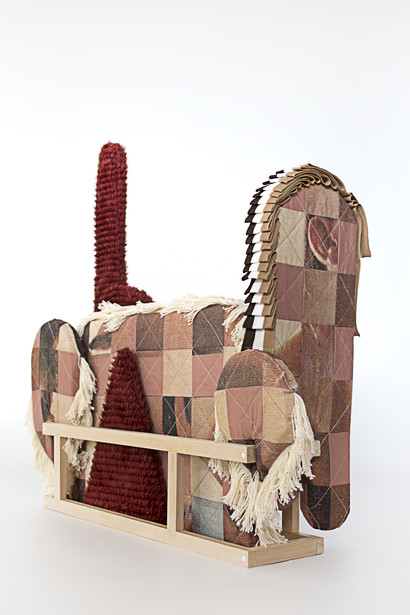
Finally, Jade Yumang presents a number of soft sculptures based on a specific issue of Drum – the first magazine in US history to show full frontal male nudity (December, 1965) and an innovative periodical in LGBT history. This was a more in-your-face and unapologetic non-hetero magazine that caught fire around the country until it was quashed by the US government. It seemed to model itself, somewhat, on Playboy, as it contained naked photos as well as thought-provoking articles. Its founder, Clark Polak, in fact, once stated that he was not shooting to become the MLK Jr. of the gay world, but instead the Hugh Hefner, perhaps realizing that private “vice” often becomes public “virtue” anyway. The issue Yumang references is from May, 1966 (volume 6, issue 1, 1966), which was seized by the post office as pornographic (Polak was, ultimately, indicted by the federal government). Yumang takes pictures and text from the issue, prints them on fabric and cuts and sews them into “abstract, queer forms.” Yumang informed me he is referencing memory quilts normally meant to remember or celebrate a relative. Each piece refers to a page from that historically significant issue. Yumang scanned pages and transferred them onto fabric, quilted them, and then made this into sculptures with materials from the era. Yumang explained that “…fabric is a form of second skin and historicizes a particular period via style/fashion. Quilting is also a way to protect or envelop someone (duvets) or something (moving blankets).” The show runs until March 24.

Sunday, July 4, 2021

Fashioned from Nature - Design Society (Shenzhen), from the Victoria and Albert Museum (Summer, 2021)

{{{Please click on images to enlarge them.}}}

The irony of Fashioned from Nature is that this is such a beautiful show about the destruction the fashion industry has wrought on the environment. This is not a comprehensive look at fashion from 1600 to the present, but, instead, the show uses samples of clothing from 1600 onward to look at how nature has been exploited and harmed to effect beauty, marketability and extravagance in our clothing. Indeed, an irony within the irony is that beautiful images from nature have often been design elements inherent in the production of clothing which harms nature.    


The show reveals that even before the Industrial Revolution clothing and fashion were manufactured in often wasteful and lavish manners. We see, for instance, a dress for the royal court of London requiring materials from several geographical regions, including mines in Bolivia where an indigenous population was used as slave labor. Later in the exhibit we see that, these days, in order to manufacture one tee shirt, even more geographical locations come into play than for that dress. The desire each of us feels to look and feel good has hampered attempts to reign in the fashion industry’s unhealthful relationship with the environment.


It was the international trade networks established by the UK, and wealth generated from these networks, which allowed the Industrial Revolution to expand rapidly and the textile industry was a chief engine in the growth of factories, population and pollution of the air and water. The consumer economy developed in the UK (where cheap, mass-produced goods replaced hand-made production) magnified the waste and extravagance already involved in the production of clothing. Thus, the fashion industry has become one of our chief polluting industries, currently producing a massive amount of carbon emissions and consuming and contaminating vast amounts of our water.

The goal now in the fashion industry seems to be to try to go back to square one and begin producing longer-lasting clothing without the harmful waste of water and production of waste usually involved. And the show reveals how each major material in the production of clothing has presented problems. The dyeing of silk released massive waste pollutants into water supplies. To obtain flax fibers in order to produce linen, stalks had to be weakened through soaking, thus polluting sources of clean water. The processing of wool produced wastes that went into river systems. The bleaching of cotton caused the first acid rain. Cotton also exhausted, and continues to exhaust, water supplies as a “thirsty” crop. Hundreds of gallons of water go into the production of just one cotton dress shirt. The fashion industry has also contributed to the over-hunting of animals and there are examples concerning whales, beavers, wolves, seals, various types of birds, crocodiles, snakes, lizards and even beetles in the show.


The show does shift, ultimately, in a more optimistic mode as a number of recent innovations in the manufacturing of clothing are presented. We learn that more environmentally friendly clothing is now being produced by designers using longer lasting fibers like linen. Recycling has now also become a big trend as hundreds of thousands of tons of old clothing often go into world landfills. The current recycling trends not only involve old clothing but also the use of plastics. Production of flax only using ground water and rain is a method more ecologically friendly than cotton. Various well-established fashion companies are also lauded for producing cotton products using less water and leaving less of a carbon footprint. Yet, 1) free trade outsourcing using low-wage labor in countries with minimal environmental regulations, 2) new groups of consumers in developing countries and 3) the ease of e-commerce are still ensuring non-sustainable fashion production.


This show will definitely alter your perception of fashion and clothing and even compel you to take a closer look at how you consume and use clothing. It poses the question of whether anything can overcome the human vanity which has propelled this industry forward. As the world becomes more rich, and fewer are left in poverty, the need for attractive fashion will only grow. The conundrum for the fashion industry is how to meet this burgeoning need while significantly reducing carbon emissions and the pollution of our water supplies. Can attractive and durable clothing actually be produced sustainably at bargain prices so that people will effortlessly buy in to the sustainable clothing movement? Relying on individual conscience to promote this movement may not be enough.


This show was curated by the Victoria and Albert Museum and runs through June in Shenzhen - the Design Society is the exclusive Chinese venue. Indeed, an additional component to the show about traditional Chinese clothing materials and sustainable design in China has been added to the exhibit by the Design Society. If you are in China, hop on a highspeed train and take a look at it. If you are not in China, I hope this show can travel to your city as well. This is the type of exhibit that compels one to address a major social/environmental issue while examining one’s own behavior. There are not enough exhibits as meaningful as this one.


This review was also published on the website: The Good Men Project https://goodmenproject.com/featured-content/review-fashioned-from-nature/

This review was also published in E The Environmental Magazine https://emagazine.com/review-fashioned-from-nature/

Thank you to both of those excellent platforms for carrying this review.