Showing posts with label socially committed art. Show all posts

Monday, July 5, 2021

Historical Amnesia - Group Show at BronxArtSpace (February 2018)

BronxArtSpace is an invaluable resource in New York City which provides opportunities for curated group shows and performances that allow artists the space to experiment and do work outside of commercial considerations. The most recent show, Historical Amnesia, was curated by Gabriel de Guzman, who brings together five amazing artists around the theme of forgotten histories and “…the lasting effects of colonialism, exoticism and intolerance on today’s culture.”

When Islam arrived in the Philippines in the 1300s, through traders and missionaries from Malaysia and Indonesia, it began to supplant a type of polytheism, magical ritual and shamanism of the indigenous population. In the late 1500s Miguel López de Legazpi arrived from Spain expressly to “save” the Filipinos from both paganism and Islam and a type of religious war lasted into the 1800s. Spain finally gained ascendency and many Filipinos converted to Catholicism, until the US took control of the Philippines and US missionaries attempted to introduce various forms of Protestantism. So Philippine history and culture have been continually altered by warring dominant cultures as this chain of islands served as a battle ground between countries and religious ideologies. What is left of indigenous Filipino thought, religion or culture? How has the character of the Filipino people been developed or affected by the abuses to which they have been subjected throughout history? Can the Philippines finally chart a course toward autonomy, self-development and unique identity?

{{{Please click on images to enlarge them.}}}

You are probably not going to get these answers through National Geographic or other glossy magazines, which tend to sell the exoticism of the Philippines to the potential American tourist. Sara Jimenez has, therefore, in response to the tendency to overlook the tragedy of Philippine history and current social problems for the delightful pleasures the country might offer to wealthy foreigners, created a type of exotic creature called the Antipode for this exhibit. This is a long, willowy creature composed entirely of nature images from National Geographic articles about the Philippines. Of course, an “antipode” is the direct opposite position of another place on the planet earth and figuratively the antipode for the Philippines rests at the heart of white, European culture. This sculpture was apparently inspired by some strange sea creatures which have recently washed up in the Philippines, allegedly spawning legends and articles in National Geographic. The Antipode defies categorization and seems to point to terrible omens for the future. It represents, perhaps, exoticism as “historical amnesia” - a pleasant cover-up for what the major powers have done to these islands and both a creation of and a curiosity for the West. The Antipode represents the Philippines as part of a cabinet of curiosities for its former colonizers and current tourists.


Joiri Minaya also takes the theme of exoticism as a starting point for her work. Of Dominican descent, on her website she mentions a type of gaze that is thrust upon her due to her race/ethnicity which “others” her. “I turn it upon itself, mainly by seeming to fulfill its expectations, but instead sabotaging them, thus regaining power and agency. Inter-disciplinarily, I explore the performativity of tropical identity as product: the performance of labor, decoration, beauty, leisure, service.” Documentation of a performance series she engaged in at Wave Hill, a garden and arts center in the Bronx, is presented in the show. Women dress in floral outfits to either blend in or stand out from the flora at Wave Hill. Women are literally equated to or contrasted with the exotic foliage as an example of the restrictive effects of objectifying and commodifying women from non-dominant cultures. Recall Gauguin and how the liberatingly exotic was exemplified by the naked female natives and their jungle surroundings. She also seems to satirize the concept of the allegorization of women, in general, based on the woman’s ability to provide sexual pleasure to men and to spawn offspring. Throughout history the “fertility” of women has been equated to the fertility of the land and throughout western literature a woman has often been presented as the spiritual fulfilment of the wandering, searching male. The capacity of a woman to provide sexual fulfilment and offspring allowed her to become symbolic of the fulfilment of spiritual desire (represented by the male sex drive). So the vagina becomes the basis of much of what art, religion and literature has extracted from women for use in very linear and bizarre allegories of spiritual development. As the restrictive outfits in Minaya’s performance impose limits to the freedom and movement of the women wearing them, this allegorization of women and the equating of women to the non-human and exotic is a type of imposed and restrictive history.


jc lenochan, a veteran teacher and professor, looks at race in his works, which are done on black boards as a reference to what normally passes for knowledge and insight in American schools. One large (very humorous) work, depicted on a blackboard, evoking Duchamp and Picabia, is of a “deracing” machine: a giant construction in which a person can climb an escalator and descend through a cleansing mechanism to have his/her race removed. The implication seems to be that race is a deliberate construction meant to create a power imbalance between societies and classes. In another work we see a giant version of the artist himself with various members of other ethnic/racial groups brushing him, sardonically trying to get his “whiteness” to rub off on them. This seems a take off on the idea of dominant culture whiteness rubbing off on others in the cultural assimilation process. In reality, in regard to white folks assimilating folks of color educationally and culturally, there is research which indicates that white teachers often undervalue and fail students of color due, in part, to the inability for whiteness to rub off on folks who do not want to absorb whiteness as a part of their education. lenochan also addresses the theme of boxing in some of his latest work as it relates to issues of race and social class mobility.


Kris Grey is represented in this show through a videotape of their performance Homage. (By way of explanation, to be ‘queer’ means to defy a binary gender stereotype and so Grey uses the possessive pronoun ‘their’ instead of ‘his/her’ in describing their performance.) As is pointed out in the show booklet, “Grey’s work provokes a discussion of transgender politics by revealing the body as a site of vulnerability and trauma.” In this performance Grey inserted 10 three-inch needles under scars left under their pectoral line. The needles force the scars to become more visually prominent. From parts of the performance I observed, Grey inserts the pins with relative aplomb, despite the blood which flows from the wounds, as we see members of the audience wincing. Actually, watching the audience feel emotional pain, and feeling discomfort and pain myself, based on what Grey was experiencing, was the most meaningful part of the performance for me. Grey finds a way to connect with folks and to engender a fellow-feeling through his experience, and thus make personal history meaningful to others, based on the transitioning process for genderqueer people.
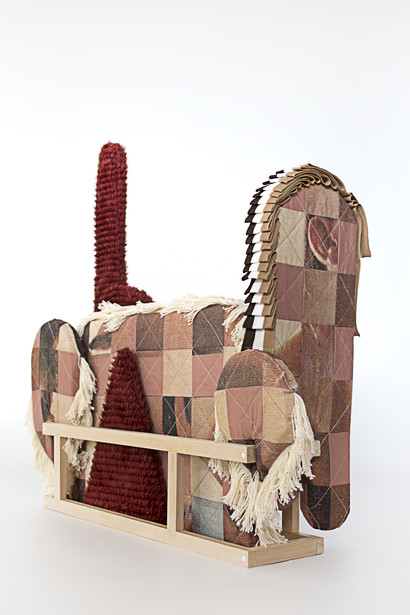

Finally, Jade Yumang presents a number of soft sculptures based on a specific issue of Drum – the first magazine in US history to show full frontal male nudity (December, 1965) and an innovative periodical in LGBT history. This was a more in-your-face and unapologetic non-hetero magazine that caught fire around the country until it was quashed by the US government. It seemed to model itself, somewhat, on Playboy, as it contained naked photos as well as thought-provoking articles. Its founder, Clark Polak, in fact, once stated that he was not shooting to become the MLK Jr. of the gay world, but instead the Hugh Hefner, perhaps realizing that private “vice” often becomes public “virtue” anyway. The issue Yumang references is from May, 1966 (volume 6, issue 1, 1966), which was seized by the post office as pornographic (Polak was, ultimately, indicted by the federal government). Yumang takes pictures and text from the issue, prints them on fabric and cuts and sews them into “abstract, queer forms.” Yumang informed me he is referencing memory quilts normally meant to remember or celebrate a relative. Each piece refers to a page from that historically significant issue. Yumang scanned pages and transferred them onto fabric, quilted them, and then made this into sculptures with materials from the era. Yumang explained that “…fabric is a form of second skin and historicizes a particular period via style/fashion. Quilting is also a way to protect or envelop someone (duvets) or something (moving blankets).” The show runs until March 24.

Wednesday, October 14, 2015

The Propaganda Value of Money - Cash is King, Lisa Alonzo, Claire Oliver Gallery

{{{click on images to enlarge them}}}

George Washington knew a thing or two about money. Actually, like most Virginia tobacco farmers, he knew how to borrow it, live lavishly on it on his slave plantation, and not pay it back to his English creditors. The historian who wrote the book ‘Tobacco Culture’ postulated that Washington and other Virginia farmers supported independence so much because it was the only way they knew of to get out from under their debts – nothing like a revolution to cancel the money you owe to your ‘oppressor’. As president he appointed Alexander Hamilton to run the economy and, basically, Al took care of things. When you run a slave plantation, you learn how to delegate jobs well.


But George Washington, along with a number of other dignified looking bozos, is on our money, and, in fact, the people who wind up on money and the reasons they wind up there seems to be the basis of the eye-catching paintings by Lisa Alonzo at the Claire Oliver Gallery. Unlike artists in the past who painted money as a comment on capitalism or consumerism, Alonzo is not as interested in the money per se as she is in the propaganda value of the money and the sneaky validation of ideology we see on it.


Ostensibly, the use of US government figures from the past on our currency can seem to represent the partnership between government and industry that constitutes our country. Indeed, this might be the government’s lame attempt at convincing us that they control the money and the basic financial operations of the country, despite the fact that 2008 showed, again, they have no control and no idea what’s going on. In regard to state formation, there’s always the question of what is the relationship between the state and industry and how autonomous the state might be from industry and how much control it might have over the business sector. Our currency would have us believe the state is firmly in control. The state has its guys (white guys) plastered all over the money to prove it.


But why did they choose these guys? Indeed, there is a lot of irony in the show. For instance, few Americans know much about Ulysses S. Grant’s two presidential terms. His administration is considered one of the most corrupt in the history of the country. It was during his administration that the Credit Mobile scandal occurred as well as the Black Friday of 1869 which led to an economic crisis. So throw him on the $50 bill. Why? I don’t know, he has a nice beard and looks presidential? He fought to free slaves as a general but continued the genocidal war against Indians as president – Custer died during his term (some say Grant hated Custer and wanted him to die anyway) trying to steal the Black Hills away from the Sioux after gold was found there. Generally he messed things up for 8 years. Alonzo doesn’t have Andrew Jackson portrayed because I’m guessing that would have been overkill – the guy didn’t believe in banks, destroyed Hamilton’s Bank of America, and kept his money in a box under his bed. So he gets the $20 bill.


In her notes Alonzo also points out the cavalier attitude Lincoln had toward money – often printing it as if it were going out of style, raising inflation and putting more and more of it into the pockets of the wealthy. In the book ‘Capital City’ we read that while men were dying at Gettysburg, fat-cat bankers and industrialists were covered in diamonds on Wall Street. And isn’t it time for a re-visiting of Lincoln anyway? Some historians have asked whether it might have been possible to resolve the slavery issue through peaceful means (boycotts, diplomacy, incentives) – Lincoln never considered any of this for a moment. He just rushed headlong into war. 600,000 men died in the Civil War (half of all soldiers ever killed in US wars) and after the war was over the folks who had been slaves merely moved from slavery to becoming dirt-poor share croppers for their previous masters. Lincoln had zero plans to integrate freed blacks after the war (he had speculated on shipping them back to Africa) and they became an oppressed underclass in the USA. So throw this guy on the $5 bill and shout hallelujah, Lincoln freed the slaves.


To show that the US is not the only country to do this, Alonzo also has Mao abstracted from some Chinese money: Mao, who may have been responsible for up to 80 million people being killed, and who tried to level his society through the Cultural Revolution. Nice guy for some currency. So even Commie countries put their leaders on their currency to try to make it seem as if the state knows what it’s doing; but how effective is this when the guy was an inveterate butcher? Or is that the point? Are we daily subjected to these folks to acclimate ourselves to their ilk and the processes that put them and keep them into power?


So I guess one big question is, do we even notice these political figures on the money? And, is that the point? The government wants us to tacitly accept the legitimacy of a president like Grant by using currency with Grant on it? They want me to buy into the myth that Lincoln was a genius even though he was responsible for 600,000 deaths? They want me to use a bill with a racist and genocidal maniac like Jackson on it without protest? This is some plan somewhere? Actually Alonzo highlights a process that is all around us – the glorification and lionization of utter mediocrities about whom we know little or nothing. This seems to be at the heart of her money paintings – we don’t know them nor their history, but we accept them without a word of protest or questioning. It’s all part of a docility training we have become accustomed to. 

Friday, April 17, 2015

Brian Maguire - The Absence of Justice Requires This Act - Fergus McCaffrey Gallery

{{{click on images to enlarge}}}

The city of Juárez Mexico has launched a public relations campaign. Heartened by the fact that the city went from the #1 ranked murder capital of the world, just a few years ago, down to #38 these days, the authorities want you to know that “Juárez is waiting for you!” Yep, it’s right over that big fence the US government put up a few years ago. No need to fear kidnapping, murder, mutilation, torture, gang rape nor extortion, according to a January article in London’s Daily Mail, all of that has conveniently moved east to the Juárez Valley where the Sinaloa and Juárez cartels may still be at war with each other, even though the Sinaloa cartel may have finally secured control of Juárez City (ergo the decline in killings). The population of “Murder Valley,” nevertheless, has dropped from 60,000 to 5,000, fertile cotton fields lie unused, ghost towns abound, folks are tortured, have their heads cut off, ransom money is sought, folks get mutilated. Same old same old – but it’s no longer in Ciudad Juárez and it’s on their side of the fence.


Irish painter Brian Maguire has worked regularly in Juárez since 2010 (when 3,622 people were killed) and has 14 powerful and affecting pieces currently on display at the Fergus McCaffrey Gallery which he completed from 2012 to 2014. His documentary film Blood Rising is also being shown. This is about the ‘feminocidio’ – the murder of 1,400 young women in Juárez since 1994. If you drop by the gallery please give yourself enough time to sit down and watch this.

Of course, if we look at the history of art, before Daumier and Courbet, social suffering, or the plight of those who had been marginalized or victimized by other segments of society, was, essentially, ignored.  Bourdieu points out that the depiction of social suffering begins more regularly in art during the class conflict of the 19th century.  Basically, the only ‘suffering’ depicted in Western art before that general time seems to have been the suffering of Jesus, Christian martyrs, people in hell or mythological figures.  When social class did become apparent in art, before Daumier, the peasants were often idealized and did not seem to be in any real pain. With the rise of the middle class and representative governments in the 19th century, we also seem to get the creation of a ‘journalistic’ or ‘activistic’ concern for identifying and solving social problems.  The depiction of social suffering, suddenly, in the 1800s, became possible in art.


Many of the images of the Maguire show go beyond mere documentation of social suffering and invite a reflection on our capacity to be inhumanly cruel. It’s Melville’s “Mystery of Iniquity” question restated. What is it that can push a person so far as to calmly hold a telephone over a woman being raped so that her father can hear what’s happening (in order to exact a ransom fee)? Or to contact a relative about a ransom and then to suddenly increase the ransom price because the family was too eager to pay? Where does this come from? Is it circumstances? Do we all harbor this capacity? What stops most of us from sinking this low? What pushes some of us to plumb these depths of moral depravation and insane inhumanity? Maguire is not trying to capture suffering in these paintings, he is shooting for horror. He is trying to convey the abject horror of what was happening across a river and a fence from us in a relatively small city due to the raw greed, lust for power and ambition of human drug traffickers and the federal police in Mexico who were apparently stuffing their pockets while all this horror was occurring.


Indeed, the Washington Post reported that 1,286 cities in the USA have been infiltrated by the Sinaloa drug cartel. Chicago is a major hub for the Mexican drug pushers who use the massive street gang infrastructure (100,000 members) to peddle drugs to African Americans in the racially segregated inner city. So Maguire is also saying that this is not really on ‘their’ side of the fence. The Mexican Federales are not the only incompetent and corrupt buffoons allowing this horro, we may have our own incompetent and corrupt politicians and police looking the other way or stuffing their pockets. Over $20 billion goes back to the cartels from the USA each year. When upscale New Yorkers buy their weed or cocaine, money might be going straight to these guys to support their operations. Some folks won’t eat meat, but they’ll buy drugs and help keep a murderous cartel in business.


So Maguire, weaned on the injustices suffered by the Irish under foreign control, follows brilliantly in the tradition established by Daumier and Courbet. He doesn’t challenge us to stare in mawkish, voyeuristic  wonder, but, instead, he challenges us to get angry, to really become aware and outraged. His images demand that we acknowledge that a fence isn’t good enough. We need to fix our social problems and be aware of the need to help our neighboring ally to address inequity and poverty there as well. He seems to want to shake us out of the lethargy and self-absorption of our safe 1st world society, to demand justice for those our government has put behind a fence to suffer whatever the drug lords decide they can get away with in a society where the government (and ours) might be too corrupt to take effective action to protect its people.