This past year I began collaborating with Wall Street International and Artillery Magazine, after posting for several months at Arte Fuse. This top-ten list is, however, exclusive to this blog.
I reviewed over 70 shows this past year, and it was (REALLY) hard to narrow them down, but I chose these ten for purely subjective reasons. I loved every show I reviewed, or I would not have reviewed it. Indeed, please scroll through the past 12 months of shows - you will see some amazing work and read some thought-provoking interpretations (with which you may or may not agree). Here's to a better year next year for all of us...
The Proletarian Art Snob's 10 Favorite Shows of 2015!
Without further ado, here are my 10 favorites:
1. Bradley Hart - Bubble Wrap Art at Anna Zorina Gallery

{{{click on images to enlarge them}}}
Click for the entire review:
http://artgallerystuff.blogspot.com/2015/04/bubble-wrap-art-bradley-hart-at-anna.html
"Hart uses bubble wrap kind of in the way a street artist might use a wall. Indeed, the Berlin Wall before its take-down by the people of Germany is even one of the images in the show, as, perhaps, a self-reflexive gesture. But Hart’s refusal to allow something to go to waste and his desire to make use of the most useless type of cast-away thing requires that he engage in a super-laborious process of creation. He injects acrylic paint into each cell of the bubble wrap, cell by cell, methodically, in what might even be called a type of proletarian process art.
He’s basically a ‘worker-artist’ or he’s like a Japanese full-body tattoo artist, engaging in a repetitive process of injecting ink over and over again into human flesh. Yet, he could also be considered to be in the tradition of the great tapestry makers of the Middle Ages, who worked with a negative image and who looped thread continually from the negative side to the front side of the tapestry and back again to get large narrative images from thousands of little stitches."
----------------------------------------------------------------
2. Kysa Johnson - The Long Goodbye at Morgan Lehman Gallery
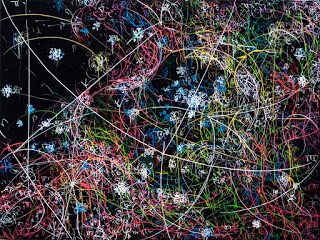
http://artgallerystuff.blogspot.com/2015/09/kysa-johnson-at-morgan-lehman-subatomic.html
"So my take is that we seem to be dealing with two types of decay in Johnson’s pieces – one toward stability and one toward expiration – the first type of decay involves matter being reduced to a stable form but the macro decay depicted seems to be all about the inevitable loss of energy production when hydrogen and helium burning drops and the star is overtaken by the forces of gravity. In fact, electrons and neutrons actually prevent total ‘black hole’ collapse in low and medium mass stars. So the first type of decay is being used to help visually depict the second type of decay. Actually we get ‘descriptions’ of subatomic decay being used to represent ‘images’ of astronomical superstuff: as if we can never really even see or experience natural phenomena directly anymore due to our overactive cognitive capacities. All experience comes through the mediation of the intellect now."
-------------------------------------------------------------------------
3. Alison Rossiter at Yossi Milo Gallery

http://artgallerystuff.blogspot.com/2015/03/alison-rossiter-at-yossi-milo-gallery.html
"So what does it mean to take very old photographic paper and develop it without first going through the process of employing a camera? By engaging in this process, to me, she is rejecting or repudiating what photography normally gives us or convinces us to believe. She repudiates a radical divide between the inner and outer worlds as well as rejecting a way of engaging what we perceive as the outer world. That the world is filled with objects separate from oneself is continually validated throughout the process of conventional photography. We believe that the photograph gives us reality and objectivity, yet, the film we use has expiration dates because the colors and sensitivity of film alter and fade throughout time. Photography is our effort to use chemicals, paper and light to create images to convince us that there is an outside world to be sufficiently understood through measurement and equations."
-------------------------------------------------------------------
4. Kim Cogan - Arcadia Gallery

http://artgallerystuff.blogspot.com/2015/10/kim-cogan-other-side-arcadia.html
"Kim Cogan contributes a meaningful and thought-provoking twist to the photo-realist tradition at Arcadia Contemporary in Lower Manhattan, as he uses photography in this show to help “reconstruct how the mind remembers”. In the notes for the show Cogan writes, “By combining old photographs with new ones, I wanted to make a complete image, very similar to how you might construct a memory in your head.”"
---------------------------------------------------------------------
5. Erin Smith - Amy Li Projects

http://artgallerystuff.blogspot.com/2015/11/the-lie-of-purely-figurative-or.html
"In the work of Smith we seem to see an attempt to find a point where the unity of inner and outer reality blend in the process of expression. It’s as if Smith is saying we can’t look at the inner world without reference to the outer world and vice versa. The process of introspection is multivariate and complex and, furthermore, not all of it has to be caught in the process of introspection for introspection to yield meaningful results. Smith seems to hint at what we should look for when we look inside and outside at the same time."
---------------------------------
6. Kelly Reemtsen - DeBuck Gallery

http://artgallerystuff.blogspot.com/2015/10/kelly-reemtsen-at-de-buck-gallery.html
"So, is she implying that her characters can now perceive their situations more starkly and are no longer trying to ‘feminize’ tasks created by men (which is what the tools might represent)? Many radical feminists believed that feminism was supposed to be much more than ‘integration’. It wasn’t just women stepping into heretofore male roles and doing what men did. There was a belief that there were feminist values that could transform the world. Feminism was not supposed to be integration, but transformation. So in this show, perhaps, these are women realizing that feminism as integration is a huge error.
These women can handle men's jobs, but they recognize them as men’s jobs reflecting values that have harmed society and the planet (notice most of the tools are for digging into the earth and cutting trees), but they still also seemed compelled to aspire to be super-feminine to appeal to the tastes of these oppressive power brokers who established the system into which they can integrate."
-----------------------------------------------
7. Nicolas Guagnini - Bortolomi Gallery

http://artgallerystuff.blogspot.com/2015/01/the-ambiguity-of-erect-penis-nicolas.html
"In Nicolás Guagnini’s wonderfully penis laden show at Bortolami, though, we have to ask the question: What is the erect penis now as a raw symbol in a secular age devoid of both shamans and a belief in fertility magic? Actually, Guagnini puts the penis within the perspective of contemporary economics as he, among other things, asserts that Freud’s little boys who feared castration have evolved into the ‘spectacular patriarchy of late capitalism.’
In fact, Yanzhen, a friend of mine who is getting her PhD in business, had an interesting take on Guagnini’s use of the erect penis. Her take was that the penis aids in the construction of male selfhood and arouses thoughts and desires for private property. Private property and the allocation of wealth is also passed on along one’s bloodline creating inequality. Allocation after production is based on maximizing the interests of one's own interest group, which is usually one's bloodline. This becomes the foundation of an economy, social structure and political system."
----------------------------------
8. Jeenah Moon - SoAM Studio

The photos seem to show people who perhaps have had little contact with the government and who, perhaps, have not been affected, either positively or negatively, by the policies of the junta. The people do not seem to be dying in the streets and seem to have adjusted to a lifestyle of simplicity. In fact, I think this is the key to grasping the basic truths of these images. We see a kind of timeless Burma in the photos. The residents around Inle Lake are Buddhist and live in bamboo huts. It's an image of people who have lived in this area for generations and who will live here for generations, away from the political turmoil of the big Burmese cities.
------------------------------------------------------------------
9. Ray Bull - Ana Cristea Gallery

http://artgallerystuff.blogspot.com/2015/07/ray-bull-impugns-abstraction-at-ana.html
"The work of Ray Bull at Ana Cristea Gallery openly impugns the autonomy of abstraction. In the notes accompanying the show it is stated that, “Ray Bull’s paintings speak to the impossibility of abstraction in painting. His compositions consistently straddle the line between representation and abstraction.” So basically Bull seems to be implying that when you look at a work of abstraction, in order to get anything from it, you engage in, basically, the same thought-processes that you use for a representational piece."
------------------------------------------------
10. Masumi Sakagami - Walter Wicksier

(Taki)
http://artgallerystuff.blogspot.com/2015/01/masumi-sakagami-renee-lerner-and-judith.html
"What I liked about Masumi Sakagami’s sumi pieces at Walter Wickiser Gallery was the way she gets an expressive look and feel by overtly experimenting with how dark and how light she can get her lines merely by adding water to the sumi ink. In SUN SUN II we literally see hollow lines to the right of the piece. Density and hollowness become binary extremes or parameters for the rest of the action going on in this work. It gives a type of pulsing effect to the piece, of controlled appearance and disappearance happening within an overarching inner process which is being visually depicted.
Taki looked a bit to me like Tatlin’s Monument to the Third International done in a calligraphic style. Indeed, the shape of the image seems to be like a right triangle with the hypotenuse made completely of hollow twisting and turning lines. In fact, by turning the image over in the booklet that comes with the show, I realized that if you treat this figure as a right triangle, and turn the image so that the hypotenuse runs from the lower left corner to the upper right corner of the page, you see the lines becoming more hollow as they approach the line of the hypotenuse. Or, if you just keep the image positioned as it is presented, you see a movement from density to lightness from left to right.
The right triangle, in the esoteric tradition, represents the creation of new life or a new being – the adjacent line on which the right triangle lies is considered masculine, the opposite side (created through the 90 degree angle) becomes the feminine and the hypotenuse is the new being (after all, ‘c’ squared equals ‘a’ squared plus ‘b’ squared). Is Sakagami playing with the triangular form here deliberately?"


