Friday, January 29, 2016

Wheiza Kim at Gallery d'Arte (Transcendence and the Möbius Strip)

{{{click on images to enlarge}}}

“My intention is to decipher the message of the universe delivered by the wind which has been engraved in wood grains like some secret codes, and then visualize it.” Wheiza Kim


In the transcendentalist tradition of landscape painting, it was believed that the mind should not be considered to be separate from nature, and those painters attempted to create art showing or even inviting a union between the mind and nature. Science and its method seemed to call for a division and the union sought was, therefore, not mediated through the intellect, which allowed for the desecration and exploitation of the natural. Yet, we cannot deny the effect that our experiences and knowledge of nature have on us when we attempt to feel what the transcendentalists have always promised. When Walt Whitman wrote about abandoning the lecture of the learned astronomer in favor of gliding out into the “mystical moist air” and looking up “in perfect silence at the stars,” was nature going to silently infuse him with an awareness divorced from previous experience and knowledge or was his experience of the sublime going to be brought about through what he knew or wished to know about the world in the presence of the world?


Some interesting little boxes created by Wheiza Kim at Suechung Koh’s Gallery d’Arte can be considered a response to these questions. Over various landscapes she has the painted grids or lattices of windows, which are partly open, having lifted that segment of the landscape higher than its adjoining parts, creating a void. Looking into the void one sees a little area inhabited by figures reflected back to one through a mirror. So what does it mean to have a window that can be opened in these landscapes? What is that window, where does it come from, what does it reveal?


Kim, herself, told me she would like to offer the concept of a Möbius strip – that type of long strip which you slightly turn and attach end to end so that if an ant were to begin crawling on the strip it would cover both the front and back side in a theoretically endless loop of a journey. To me the windows opening the perceivable screen of nature might represent our discoveries and insights into nature through cognition and experience – ranging anywhere from the insights of Spinoza to the insights of Schopenhauer - and this means that in our attempt to get the message of the universe, the underlying essence of the world, we are directed back into a greater exploration of our own cognition, motivation, desire and emotion.  We enter a type of Möbius strip process taking us outside and inside and back again, perpetually.


Kim explained that according to Zen masters, to attain a peaceful state, your mind has to be like a mirror, otherwise the mind becomes susceptible to a type of ‘attachment’ thinking or desire, which leads to emotional agony. Along with the little figures one also sees one’s own reflection through the open window, thus becoming a part of the piece of art. To Merleau-Ponty a subject looking at himself in a mirror experiences a ‘troubled form’ of self-knowledge in that he/she perceives him/herself from the perspective of the other and realizes the form of socializing coercive force used and sometimes embraced by the individual instead of a type of inner change and development which engenders its own momentum through self-observation. Schopenhauer believed the intellect to be a mirror to the ‘will’ allowing one’s will, itself, to move toward a greater sense of self-denial.  To me, the mirror in these pieces by Kim questions the extent to which the external mirror of troubled identity or the inner mirror of cognition motivates self-development and change and to what extent change through the external mirror may actually be possible as well as the capacity of the will or aggression to ‘recognize’ itself and initiate its own change merely based on recognition of itself.


Among other pieces in the show are those in which Kim works with the natural grain of the wood to create landscape-like images.  These pieces are often made to look like traditional Asian folding screens where mirrors stand in place of the hinges. Other works explore the symbolism of the triangle in relation to stupas, yoga and urban life. The triangle, of course, is one of the oldest symbols and may have taken its form as an abstraction of a mountain. In ancient times mountains were sacred areas and the higher you climbed, the farther you distanced yourself from the effects of others and the closer you approached the spirit realm. In Sumeria the upward pointed triangle represented ‘the masculine’ or an active principle of desire seeking its conjunction with the fulfillment of the feminine.


The triangle is, in itself, a little allegory (beginning, middle, end) encompassing the transience of movement or time with the permanence of change. In the inner core of these triangle pieces are three mirrors which create complex visual patterns, the mirrors representing the minds of three people – the very basic number of people, for instance, in computerized game theory experiments to approximate a basic social unit.

The show closed on Tuesday January 26th, but Suechung Koh can be reached at gallerydarte@gmail.com if you have any questions about viewing or purchasing Kim’s work, more of which will be on display soon in LA.   


Saturday, January 23, 2016

Li Hongbo at Klein Sun Gallery - Overreliance on the Word

{{{click on images to enlarge them}}}

In his current show at Klein Sun Gallery, Li Hongbo calls our attention to the overwhelmingly textual basis of the world-wide globalized educational system, along with the numerous problems that come along with education systems so dependent on the written word and so lacking in meaningfully experiential components.


Li has several sculptures of placid, expressionless students carved out of stacks of cheap textbooks and workbooks. This seems to lead directly into the question of how the continual engagement with the written word, through education, translates into the behavior and self-development of each person. The best answer to this question would seem to come from Phillip W. Jackson’s concept of ‘the hidden curriculum’. 

In his book “Life in Classrooms” (1968) Jackson pointed out that when you take active, young bodies and restrict them behind desks for 6 or 7 hours a day, presenting them with written texts about history, science, math etc. , for which they will be rewarded for correct answers and punished for wrong answers, the students may pick up the history, science and math, but the most enduring concept they learn is ‘passivity works’ - obedience to authority figures is the way to go. 

Along with the knowledge that we pick up in school, in the very process of acquiring this knowledge we are also subjected to hidden values that breed passivity.


Of course, the contents of our text books are often problematic as well. Jean Anyon did a landmark study of US History textbooks in the classrooms of working class American students. She discovered that in regard to the history of labor unions, only those unions which had collaborated subserviently with management were included in the texts.  

The unions which took defiant stances and actively fought for the rights of workers were simply not mentioned. Anyon concluded that working class students were being sent the message – Do not protest! Collaborate! Work with your superiors! Working with your betters is always the right way to go!


We see nonsense all throughout our text books and especially our history textbooks.  The first European settlers to North America, at Roanoke, probably joined a Native American tribe but this is not reported because ‘integration’ is supposed to go the other way – people of color integrate into white, industrialized societies; white people do not ’regress’ into ‘savage’ cultures. 

And, of course, the biggest lie your US history book ever told was about the great president Abraham Lincoln who actively sought war with the South, thus causing the deaths of over 600,000 men, instead of seeking creative and peaceful solutions to the problem of slavery.  

That the Civil War was fought to end slavery is a lie as well since there was no plan to help the freed black folks after slavery and they became powerless and dirt poor share croppers, while northern carpet-baggers flooded the South afterwards to turn insane profits (the real reason for the war).


The huge binders crisscrossing the show, to me, represent the crippling and oppressive effects of the grading system, which is the Charybdis to the Scylla of the textbook. To grade students is to degrade students. The only justification ever given for grading is that it supposedly helps to ensure motivation, which, obviously, points to the fact that force has to be used to get children to learn what others want them to learn. 

A system without grading would be a system of freedom and self-discovery and the realization of full human potential. We do not have a humane system of education where students are free to pursue the most meaningful and existential threads through self-discovery, we have state approved text books and a grading system to weed out who cooperates and who does not.


On the floor of the gallery a pathway is established by books and this seems to imply progress. Yet, more realistically, it signifies the limited course that formal education is. It is a process leading in a specific direction established by others to guide entire generations in specific directions.   

Sunday, January 17, 2016

Jack Stuppin at ACA Galleries: Homage to the Hudson River School

{{{click on images to enlarge them}}}

When English painter Thomas Cole came to the US in the early 1800s, he began painting landscapes from the Hudson River Valley, attempting to capture and convey what Edmund Burke had called the sublime.  To Burke, the sublime was astonishment bordering on terror.  “The mind is so entirely filled with its object that it cannot entertain any other, nor reason on that object which fills it.” Burke also dealt with the beautiful, which was distinguished from the sublime by the capacity of the beautiful to engender a desire to possess what was being viewed.

One could argue that the environmental devastation since the time of the Hudson River School was due to a rejection of the sublime in favor of mathematical analysis and technological profiteering along with a perversion of the beautiful toward the possession of the exploitable. By revisiting the Hudson River School movement in his show “Homage to the Hudson River School”, Stuppin, therefore, revisits these two concepts in light of the development of science and technology and the ravaging of the environment for profit. He also, perhaps, questions the extent to which anyone should have bought into either extreme of transcendence or technological exploitation in regard to the American natural environment.


Stuppin uses super-enriched colors for his paintings. Sometimes the colors correspond somewhat to the colors we would expect objects to be, other times they do not. He takes the basic colors of nature, enhances them with a type of luminescence, and sometimes shuffles the colors somewhat so that, for instance, you get blue trees. Charles Burchfield admonished American landscape painters not to paint what they saw, but to paint the hidden, real presence of nature and, consequently, one might guess that these brilliant colors could be thought to reflect the élan vital we seem to sense when we engage nature on its own terms, free of cognitive and emotional baggage.


However, it could be that Stuppin points at those aspects of nature that engendered the transcendentalist tradition and hints at what gives nature its capacity to arrest and overwhelm us and con us, frankly, into believing in an élan vital. We get an awareness of our acceptance of the ancient belief in transcendence and union with nature, which has still not been destroyed through science, but which modern science seems to have refuted.  In the paintings this élan vital, therefore, is not necessarily to be believed but becomes the starting point for us to become more aware of the limits of our cognition and emotion when contemplating or experiencing nature without the aid of science.


Along with brilliant colors, Stuppin also seems to present what might be called a natural world of averages. For example, I noticed in one painting that he does not have realistically depicted small, medium and large waves or waves of many shapes and sizes vis-à-vis each other; he shuns realistic, individual depictions in favor of rolling rhythmic patterns – his waves, for instance, are basically waves you might get if you took the average size of waves in one area. We learned in the early 20th century that observation changes the thing observed and so we get objects represented by averages instead of individually depicted objects.  They are stylized waves imitating and perhaps replicating each other, perhaps intimating the concept of infinity.


Perhaps Stuppin wants to say that when we artistically depict and interpret an experience of nature, without applying any incisive background knowledge of nature to it, with viewers just standing in the presence of the depiction of nature, we are being engaged, basically, by colors and forms, no more, no less. What do we really hope to get from the colors and forms of landscapes? How might it be possible for these colors and forms to even imply a mystical or emotionally moving concept? In the direct presence of nature, colors and forms combine with our previous experiences of the textures of nature – how stone, wood, water etc. feel – as well as sound and smell.  But is this even enough to derive that something extra, that deeper knowledge or understanding that nature seems to promise us through our contemplation of it, but which may never be disclosed? 

Therefore, Stuppin might be asking whether the transcendental ‘union’ promised through much landscape art from the past is possible. Is the mind separate from nature or is it such a part of nature that it allows a deep intuition of the essence of nature? Stuppin’s work might be saying that what we experience when we engage nature is not nature but the emotions created when we desire to understand but have insufficient tools to do so – neither intuition nor science gets us to the Faustian place we wish to go. 


Intuition from an experience in a state of nature leads to mysticism, ritual or mythology, while science leads to the physical destruction of the environment. Yet, this middle ground we want between intuition and science becomes the palpable inability to grasp what we believe is possible to grasp and it becomes a grand experience in itself. The great mystery of landscape painting illustrated through the work of Stuppin is that Burke was right – in the presence of nature we are often overcome by an intense but difficult to describe emotion which subsumes everything else we might feel. It is joyous and painful and goads us to further and deeper experiences while leading to a lingering and obscure longing. Just what we are getting when we give ourselves over to that process is brilliantly and seductively represented by these perfectly executed works by Jack Stuppin. 

Monday, January 11, 2016

Art Brut in America: The Incursion of Jean Dubuffet

{{{click on images to enlarge them}}}


“Other artists identified with da Vinci or Michelangelo, in my head I had the names Wölfli and Muller...It was these artists whom I loved and admired. I was never influenced directly by Art Brut. I was influenced by the freedom, the liberty, which helped me very much.”  Jean Dubuffet


It was Hans Prinzhorn’s 1922 book Bildnerei des Geisteskranken (Artistry of the Mentally Ill) which blew Dubuffet away and turned him onto what he would later characterize as Art Brut.  It was not so much what Prinzhorn had written – Dubuffet could not read German – it was the imagery itself which opened Dubuffet’s eyes to the limits inherent in what he called l’art culturel (official art) “…the activity of a very specific clan of career intellectuals.” He would begin to classify Art Brut pieces as possessing the compelling power of a unique type of expression, free from established cultural trends or influences.


The American Folk Art Museum’s show ‘Art Brut in America: The Incursion of Jean Dubuffet’ commemorates the temporary relocation of Dubuffet’s collection to the US in the 1950s, during a period of time when Dubuffet was trying to find his own way as an artist while simultaneously collecting and promoting work he felt to represent a purer impulse to create than what was found in ordinary gallery pieces – work which entailed a more immediate and compelling engagement between the viewer and the work due to the inherent sincerity of the creator of the work.


The extent to which one can be engaged by these works and derive meaningful interpretations or insights from them is a bit ironic in that leafing through the bios of the artists at the show one reads that some of these artists, who had been institutionalized, surreptitiously created their work, apparently afraid to be caught for some reason or another. Therefore, some, if not much, of this art was created with the belief it would not be seen and had to be hidden away. The implication is that an artist who wants to get to and visually express something of the utmost meaning to him/herself becomes more relevant to others through a sense of urgency and desperate need to express.


Indeed, it was not the ‘insanity’ or lack of formal education or outsider status that made these pieces remarkable to Dubuffet (there are artists in the collection who were not classified as ‘insane’ and some were formally educated). It was the ability by an individual to create a new visual language from scratch, while ensuring that any viewer would immediately be able to pick up this new language, be affected on a deep level by the image created through the language and treasure this new language beyond the prevailing dead languages of art. It was not about individuals selecting from aspects of the canon to express what they understood – it was about deliberate ignorance of the canon so that something original and true to the artist’s own experience and insight could come out. 


In his famous speech in Chicago in 1951, Dubuffet predicted “…a complete liquidation of all the ways of thinking whose sum constituted what has been called humanism and has been fundamental for our culture since the Renaissance…”.  Art Brut represented a shift in values from what had become established through various forms of corruption and educational/cultural coercion to what had been held in contempt but which possessed greater integrity and intuition. The need for this shift would still seem to be the case today.


While I wandered through the exhibit, reading of the lives of the creators of the pieces, I was deeply affected by the ‘brut’ (unrefined, uncontrived) and urgent humanity contained in many of the works and I was grateful for the effort put forth by these amazing souls. Having spent the past couple of years dealing with some of the self-absorbed, overly ambitious, and continually self-promoting artists, ‘critics’ and gallery owners in New York, and learning of the corruption inherent in this business of quid pro quo and artificial inflation of prices and the promotion of the talentless over the talented for ulterior reasons through the established press and other means, I left the museum and said a quick prayer to St. Catharine of Bologna for at least a liquidation of all this crassness  – may it come sooner than later. The show closed on the 10th...


Thursday, December 31, 2015

Genesis 2015 - Dan Hernandez - Kim Foster Gallery

{{{click on images to enlarge}}}

While Dan Hernandez was standing in front of the Leonardo Annunciation a few years ago at the Uffizi, he recognized similarities between the painting and the classic arcade game Street Fighter II. Leonardo has the Archangel Gabriel leaning in toward the Virgin with a stylized hand gesture indicating a greeting or blessing while the Virgin seems to be pulling back into a type of defensive posture. The placement of the two characters to the left and right of a vanishing point in aggressive and defensive postures is, in fact, mirrored by the placement of characters in Street Fighter II. Thus Hernandez began his Annunciation Fighter project, which has evolved into the Genesis series he has been showing at the Kim Foster Gallery in Manhattan’s Chelsea district.

Although the current show in the series is called Genesis 2015, his work draws from many different systems and games - Genesis, as Hernandez explained to me, was chosen as a term because it “straddles the old and the new.” He seems to be interested in combining aspects of these games into early Renaissance masters like Giotto, Duccio and Pierro, but he is also interested in “…the sheer density of information in some of the work by Tintoretto, Bosch and Bruegel, illuminated manuscripts, Indian miniatures…the list goes on and on”.  


In some of his pieces you see various saints, angels and perhaps even God ‘Himself’ participating in virtual carnage against legions of adversaries.  Indeed the legions are often differentiated from each other by the giant iconic figures among them, goading and inspiring them to greater and greater glory, and sometimes zapping guys themselves with fearsome laser beams coming from eyes, hands or, potentially, wherever. Sometimes the spiritual warriors are marshalled behind inspiring iconic figures or just organized into potential battle legions waiting to suppress the infidel or maybe even members of one’s own religion who simply live across a border.

Hernandez informed me that he is not necessarily making a statement concerning any particular current political situation and that his pieces are more about the “toy box than the battle field.” He’s “playing at violence” as his children do and that this “runs deeper than current events.” Hernandez points to an early piece by Philip Guston of children play-fighting with garbage can lids as shields and small planks of wood as swords as a reference.


Yet, Hernandez’s work also can serve to satirize the use of religions of ‘peace’ being used as means to marshal armies (throughout history) and his work can also ask to what extent religion is a motivator in conflict or just a banner used to justify conflict being pursued under ulterior motives. There’s also the absurdity of individual cultures going to war just to, basically, destroy the other culture’s religious icons and bury their stories, even though the warring cultures may have icons and texts that, basically, espouse the same principles. Armies have fought to preserve icons and stories. Whose religious meme will, ultimately, survive all this carnage, since it doesn’t seem possible for differing religious memes to coexist?

Deeper to me, however, than Hernandez’s toy box analogy is the fact that his work can also potentially parody the concept of the individual spiritual ‘journey’.  We seem to enjoy thinking of our spiritual ‘quests’ in terms of violent allegories – there is something corrupting or evil inside of us, and this must be rooted out and obliterated. The goal of every religious quest seems to be the attainment of a higher level peace or equanimity, but to attain this equanimity we have to, paradoxically, fight against an adversary the way you zap guys in video games. Of course, once you establish your state of spiritual perfection, as Hernandez shows, you need an army to protect you and your methodology from the other guy’s spiritual perfection and methodology.


Sunday, December 27, 2015

Top Ten Shows 2015

This past year I began collaborating with Wall Street International and Artillery Magazine, after posting for several months at Arte Fuse. This top-ten list is, however, exclusive to this blog.  

I reviewed over 70 shows this past year, and it was (REALLY) hard to narrow them down, but I chose these ten for purely subjective reasons.  I loved every show I reviewed, or I would not have reviewed it. Indeed, please scroll through the past 12 months of shows - you will see some amazing work and read some thought-provoking interpretations (with which you may or may not agree).  Here's to a better year next year for all of us...

The Proletarian Art Snob's 10 Favorite Shows of 2015! 

Without further ado, here are my 10 favorites:

1. Bradley Hart - Bubble Wrap Art at Anna Zorina Gallery


{{{click on images to enlarge them}}}

Click for the entire review:
http://artgallerystuff.blogspot.com/2015/04/bubble-wrap-art-bradley-hart-at-anna.html

"Hart uses bubble wrap kind of in the way a street artist might use a wall. Indeed, the Berlin Wall before its take-down by the people of Germany is even one of the images in the show, as, perhaps, a self-reflexive gesture. But Hart’s refusal to allow something to go to waste and his desire to make use of the most useless type of cast-away thing requires that he engage in a super-laborious process of creation. He injects acrylic paint into each cell of the bubble wrap, cell by cell, methodically, in what might even be called a type of proletarian process art. 

He’s basically a ‘worker-artist’ or he’s like a Japanese full-body tattoo artist, engaging in a repetitive process of injecting ink over and over again into human flesh. Yet, he could also be considered to be in the tradition of the great tapestry makers of the Middle Ages, who worked with a negative image and who looped thread continually from the negative side to the front side of the tapestry and back again to get large narrative images from thousands of little stitches."
----------------------------------------------------------------

2. Kysa Johnson - The Long Goodbye at Morgan Lehman Gallery


http://artgallerystuff.blogspot.com/2015/09/kysa-johnson-at-morgan-lehman-subatomic.html

"So my take is that we seem to be dealing with two types of decay in Johnson’s pieces – one toward stability and one toward expiration – the first type of decay involves matter being reduced to a stable form but the macro decay depicted seems to be all about the inevitable loss of energy production when hydrogen and helium burning drops and the star is overtaken by the forces of gravity. In fact, electrons and neutrons actually prevent total ‘black hole’ collapse in low and medium mass stars. So the first type of decay is being used to help visually depict the second type of decay. Actually we get ‘descriptions’ of subatomic decay being used to represent ‘images’ of astronomical superstuff: as if we can never really even see or experience natural phenomena directly anymore due to our overactive cognitive capacities. All experience comes through the mediation of the intellect now."
-------------------------------------------------------------------------

3. Alison Rossiter at Yossi Milo Gallery


http://artgallerystuff.blogspot.com/2015/03/alison-rossiter-at-yossi-milo-gallery.html

"So what does it mean to take very old photographic paper and develop it without first going through the process of employing a camera? By engaging in this process, to me, she is rejecting or repudiating what photography normally gives us or convinces us to believe.  She repudiates a radical divide between the inner and outer worlds as well as rejecting a way of engaging what we perceive as the outer world. That the world is filled with objects separate from oneself is continually validated throughout the process of conventional photography. We believe that the photograph gives us reality and objectivity, yet, the film we use has expiration dates because the colors and sensitivity of film alter and fade throughout time. Photography is our effort to use chemicals, paper and light to create images to convince us that there is an outside world to be sufficiently understood through measurement and equations."
-------------------------------------------------------------------

4. Kim Cogan - Arcadia Gallery


http://artgallerystuff.blogspot.com/2015/10/kim-cogan-other-side-arcadia.html

"Kim Cogan contributes a meaningful and thought-provoking twist to the photo-realist tradition at Arcadia Contemporary in Lower Manhattan, as he uses photography in this show to help “reconstruct how the mind remembers”. In the notes for the show Cogan writes, “By combining old photographs with new ones, I wanted to make a complete image, very similar to how you might construct a memory in your head.”"
---------------------------------------------------------------------

5. Erin Smith - Amy Li Projects


http://artgallerystuff.blogspot.com/2015/11/the-lie-of-purely-figurative-or.html

"In the work of Smith we seem to see an attempt to find a point where the unity of inner and outer reality blend in the process of expression. It’s as if Smith is saying we can’t look at the inner world without reference to the outer world and vice versa. The process of introspection is multivariate and complex and, furthermore, not all of it has to be caught in the process of introspection for introspection to yield meaningful results. Smith seems to hint at what we should look for when we look inside and outside at the same time."
---------------------------------

6. Kelly Reemtsen - DeBuck Gallery


http://artgallerystuff.blogspot.com/2015/10/kelly-reemtsen-at-de-buck-gallery.html

"So, is she implying that her characters can now perceive their situations more starkly and are no longer trying to ‘feminize’ tasks created by men (which is what the tools might represent)? Many radical feminists believed that feminism was supposed to be much more than ‘integration’. It wasn’t just women stepping into heretofore male roles and doing what men did. There was a belief that there were feminist values that could transform the world. Feminism was not supposed to be integration, but transformation. So in this show, perhaps, these are women realizing that feminism as integration is a huge error. 

These women can handle men's jobs, but they recognize them as men’s jobs reflecting values that have harmed society and the planet (notice most of the tools are for digging into the earth and cutting trees), but they still also seemed compelled to aspire to be super-feminine to appeal to the tastes of these oppressive power brokers who established the system into which they can integrate."
-----------------------------------------------

7. Nicolas Guagnini - Bortolomi Gallery


http://artgallerystuff.blogspot.com/2015/01/the-ambiguity-of-erect-penis-nicolas.html

"In Nicolás Guagnini’s wonderfully penis laden show at Bortolami, though, we have to ask the question: What is the erect penis now as a raw symbol in a secular age devoid of both shamans and a belief in fertility magic? Actually, Guagnini puts the penis within the perspective of contemporary economics as he, among other things, asserts that Freud’s little boys who feared castration have evolved into the ‘spectacular patriarchy of late capitalism.’ 

In fact, Yanzhen, a friend of mine who is getting her PhD in business, had an interesting take on Guagnini’s use of the erect penis.  Her take was that the penis aids in the construction of male selfhood and arouses thoughts and desires for private property. Private property and the allocation of wealth is also passed on along one’s bloodline creating inequality. Allocation after production is based on maximizing the interests of one's own interest group, which is usually one's bloodline. This becomes the foundation of an economy, social structure and political system."
----------------------------------

8. Jeenah Moon -  SoAM Studio
http://artgallerystuff.blogspot.com/2015/05/jeenah-moon-photos-from-contemporary.html

The photos seem to show people who perhaps have had little contact with the government and who, perhaps, have not been affected, either positively or negatively, by the policies of the junta. The people do not seem to be dying in the streets and seem to have adjusted to a lifestyle of simplicity. In fact, I think this is the key to grasping the basic truths of these images. We see a kind of timeless Burma in the photos. The residents around Inle Lake are Buddhist and live in bamboo huts. It's an image of people who have lived in this area for generations and who will live here for generations, away from the political turmoil of the big Burmese cities. 

------------------------------------------------------------------

9. Ray Bull - Ana Cristea Gallery


http://artgallerystuff.blogspot.com/2015/07/ray-bull-impugns-abstraction-at-ana.html

"The work of Ray Bull at Ana Cristea Gallery openly impugns the autonomy of abstraction. In the notes accompanying the show it is stated that, “Ray Bull’s paintings speak to the impossibility of abstraction in painting. His compositions consistently straddle the line between representation and abstraction.” So basically Bull seems to be implying that when you look at a work of abstraction, in order to get anything from it, you engage in, basically, the same thought-processes that you use for a representational piece."
------------------------------------------------ 

10. Masumi Sakagami - Walter Wicksier

(Taki)

http://artgallerystuff.blogspot.com/2015/01/masumi-sakagami-renee-lerner-and-judith.html

"What I liked about Masumi Sakagami’s sumi pieces at Walter Wickiser Gallery was the way she gets an expressive look and feel by overtly experimenting with how dark and how light she can get her lines merely by adding water to the sumi ink. In SUN SUN II we literally see hollow lines to the right of the piece. Density and hollowness become binary extremes or parameters for the rest of the action going on in this work. It gives a type of pulsing effect to the piece, of controlled appearance and disappearance happening within an overarching inner process which is being visually depicted.

Taki looked a bit to me like Tatlin’s Monument to the Third International done in a calligraphic style. Indeed, the shape of the image seems to be like a right triangle with the hypotenuse made completely of hollow twisting and turning lines. In fact, by turning the image over in the booklet that comes with the show, I realized that if you treat this figure as a right triangle, and turn the image so that the hypotenuse runs from the lower left corner to the upper right corner of the page, you see the lines becoming more hollow as they approach the line of the hypotenuse. Or, if you just keep the image positioned as it is presented, you see a movement from density to lightness from left to right. 

The right triangle, in the esoteric tradition, represents the creation of new life or a new being – the adjacent line on which the right triangle lies is considered masculine, the opposite side (created through the 90 degree angle) becomes the feminine and the hypotenuse is the new being (after all, ‘c’ squared equals ‘a’ squared plus ‘b’ squared). Is Sakagami playing with the triangular form here deliberately?"

Friday, December 25, 2015

Ha Chong Hyun - Tina Kim Gallery

{{{click on images to enlarge them}}}

Burlap, for Ha Chong-Hyun, seemed to represent both a force of resistance and a platform from which to express. When his “Conjunction” series was begun in the 1970s, burlap was a common material from US military bases and aid organizations, readily found in South Korea during that country’s darkest days of early economic development and dictatorship, and it became Ha’s choice for his paintings over traditional canvas. Indeed, Ha exploited the dual nature of burlap - a strong material that allowed a transfer of air – when he forced his paint through the ‘back’ of the woven material before using his own hands or worker’s tools to create the image presented to the viewer on the ‘front’ of the material. There are areas in many of his paintings where you still can see evidence of the paint having been forced through the burlap before being worked into mostly linear abstract patterns.  


Tina Kim Gallery in Chelsea, New York, recently presented an overview of this artist’s work in the wake of the success Ha and his fellow Dansaekhwa (School of White or Monochrome) artists have had with collectors. Interest in Ha and those of this Korean movement (stretching forward from the 70s) seems to have finally captured the attention of collectors and museums, after long years of relative neglect, due to a book by an art historian named Joan Kee and shows at ‘influential’ galleries in Seoul and LA. This seems further evidence of a burgeoning trend and niche which may be opening in the dominant art market for meaningful and overlooked art from previously ‘marginalized’ countries – i.e. the show at the Tate Modern of Saloua Raouda Choucair, a Lebanese artist who worked for decades in obscurity, comes to mind.
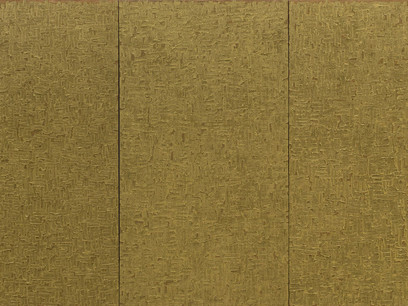

In reviews of Ha’s work, he is sometimes equated to abstract expressionists, but if there are similarities, they are probably coincidental since Ha and the others in his group eschewed any western influence. The colors Ha used are muted earth tones worked primarily, it seems, in angles or straight lines. In a country under martial law, living under a sequence of dictators, the expression of a grim, regulated, limited expression became, possibly, the most potent form of political protest. To me, Ha’s work bridges the divide between an artist’s concern for the state of his society and his own humane development within a state that denied civil rights and liberties and which was riddled with corruption. In an oppressive society, for an artist to just look inward might amount to complicity. Ha’s methodology and images potently convey the struggle to strive for greater humanity within yourself and your society simultaneously, but under great duress.


The closest western analogy to what Ha was doing might actually be the Arte Povera movement (although, again, this seems coincidental).  Arte Povera artists in Italy sought to eliminate the division between art and life and did so by using common materials and tools.  The materials and tools they used were a form of protest against industrialism in that their materials were more common before the development of industry in Europe.  Arte Povera was a rejection of the current economic system due to the waste, environmental harm and corruption stemming from it (interestingly, while the US celebrated Pop, Italy celebrated Arte Povera).

{{{Here's a close-up of how the paint is pushed through the burlap weave. The burlap, itself, could represent government censorship through which an artist has to force his art, or any obstacle requiring a use of force to overcome it.}}}

So Ha uses burlap, representative of both oppression and aid. Burlap is also a commercial commodity, as visual art is, so Ha forgoes the pretense of a canvas and uses something common to commerce. The dual nature of burlap can, moreover, evoke many contradictions. In the 70s Korea, for instance, was ruled by a dictator who is still highly esteemed among many of the older generation, and whose daughter is now the president of Korea.  Park Chung-Hee is considered both a dictator and an economic savior. The US military and US government, as a further contradiction, provided both an oppressive military presence and a reassuring presence of staving off invasion from the North.


Ha does not seem to be saying these contradictions were necessary – Kim Dae-Jung did a fine job with the Korean economy and he was no dictator – he seems to frankly acknowledge, however, the existence of these contradictions through his work. That he continues using his method to this day may imply that even in what seems to be improved conditions in his homeland, sinister contradictions may still prevail on subtle or barely perceptible levels. The recent Sewol disaster, and the massive disenchantment among many Koreans generated by the government response, comes to mind. And if Ha’s method resonates with those of us outside of Korea, it could well be due to our own concerns about sinister contradictions in our own society.


The process Ha uses seems to be one of creative force (to overcome the resistance of the burlap) and workmanship (to create an image that will arrest and engage the attention of the viewer). From the facticity of his experience in his own homeland, his process and images can stimulate the imagination of a contemporary viewer anywhere to comprehend and validate the struggle he and his countrymen endured and to elicit compassion, humanity and self-recognition as a response.


The show closed on December 12, 2015. Please refer to the gallery’s web site for further information: tinakimgallery.com